This article is part of a Worthington Pulse special edition on the city's proposed 2027 budget. Start with What's in Worthington's 2027 Proposed Budget, which links the full series.
Worthington water bills from Columbus carry a line for the city's own water and sewer surcharge: 75 cents for every 1,000 cubic feet of water used. That rate has not changed since 1958 and raises roughly $80,000 a year. Over the next five years, the city's proposed capital plan puts about $11.3 million into water lines and a sewer the state requires it to fix, and the 2027 budget pays for a rate study to inform what the surcharge should be (pp. 10, 23).
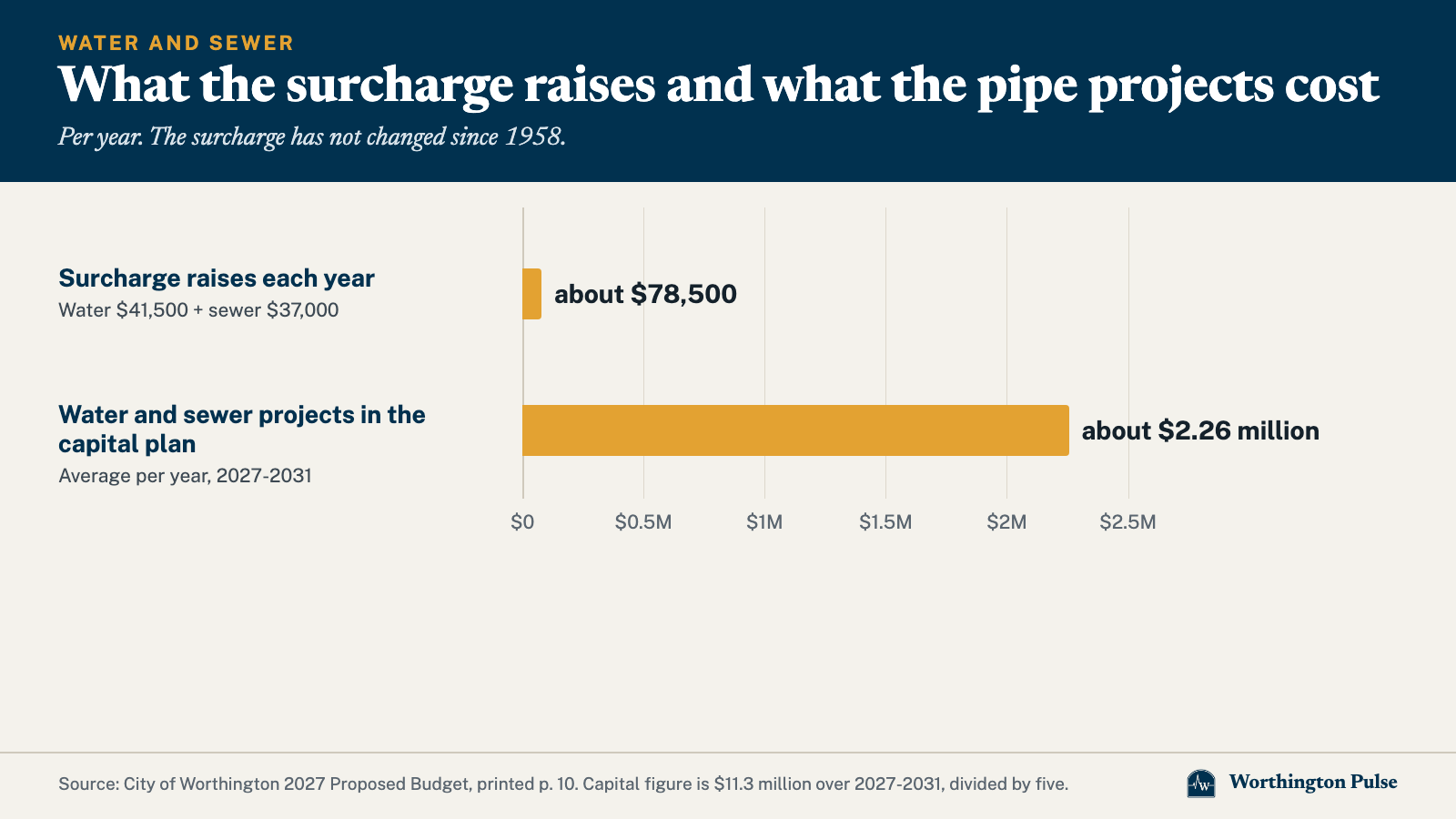
The surcharge raises about $78,500 a year; the capital plan's water and sewer projects average about $2.26 million a year. Source: 2027 Proposed Budget, p. 10.
What the surcharge pays for now
Columbus adds the city's surcharge to its water bill as a separate item, and the money goes into the city's water and sewer funds, which pay for day-to-day upkeep of the lines. The budget says the fee does "not fully cover operational costs related to servicing the water and sewer lines" and is "not enough to cover any of the capital costs." For 2027 the water fund is budgeted to spend about $266,000 and to take in $120,000: $45,000 from the surcharge and a $75,000 transfer from the general fund. The $45,000 is the budget's estimate; in 2025 the water surcharge brought in about $41,500 and the sewer surcharge about $37,000 (pp. 23, 24, 94).
A staff memo in the Nov. 16 meeting packet says: "The water fund is not self-sustaining, meaning there isn't enough revenue to cover the expenses in the fund, the General Fund must subsidize these operations." Staff's Nov. 10 budget changes add a one-time $150,000 general fund transfer to the water fund for 2027 (meeting packet, pp. 14, 55).
Larger work, replacing a water main or rebuilding a sewer, comes out of the capital plan, paid for mostly with income tax and borrowed money.
Water and sewer projects in the plan
The $11.3 million covers three water lines and the Kenyon Brook sewer, all four paid for with bonds (p. 108):
- West Wilson Bridge Road water line: about $2.8 million in 2027. Repaving the road, which the budget letter says will follow the water line work, is scheduled for 2028 (pp. 14, 109, 111).
- High Street, East South Street to the south city limit: design in 2028 and construction in 2029, about $1.7 million in all (pp. 112, 113).
- Worthington-Galena Road, Huntley Road to Schrock Road: design in 2030 and construction in 2031, about $3.7 million in all (p. 115).
- Kenyon Brook trunk sewer, High Street to New England Avenue: about $3.1 million of construction in 2028 (p. 111).
The water lines come from a Water System Condition Study the city completed in 2020. Some locations were changed to delay work in areas more likely to have lead service lines, so the city's projects line up with Columbus's program to replace those lines. The budget letter adds: "The City has experienced a large number of waterline breaks and it would be beneficial to complete more projects, however funding is insufficient to do so" (p. 13).
The plan also sets aside money for sewer repairs in 2027 and 2029, $55,000 a year to replace and paint fire hydrants, and $795,000 in 2028 for a new sewer truck (pp. 109, 113, 128).
Stay connected to what's happening in Worthington, Ohio.
The Kenyon Brook sewer and the state consent order
Kenyon Brook is the only project the capital plan classifies as a legal mandate. Worthington is under a consent order with the Ohio Environmental Protection Agency to reduce sanitary sewer overflows, when untreated wastewater escapes the sewer system. Under that order the city studied each of its sewer sheds, and the studies identified the work needed; the Northbrook sewer project, finished in 2025 with state help, and Kenyon Brook in 2028 are expected to complete it. This section of sewer was flagged for replacement in a 2011 study of the southeast sewershed, and the city already carries a small zero-interest state loan from earlier Kenyon Brook work (pp. 98, 107, 111).
Repair versus replacement
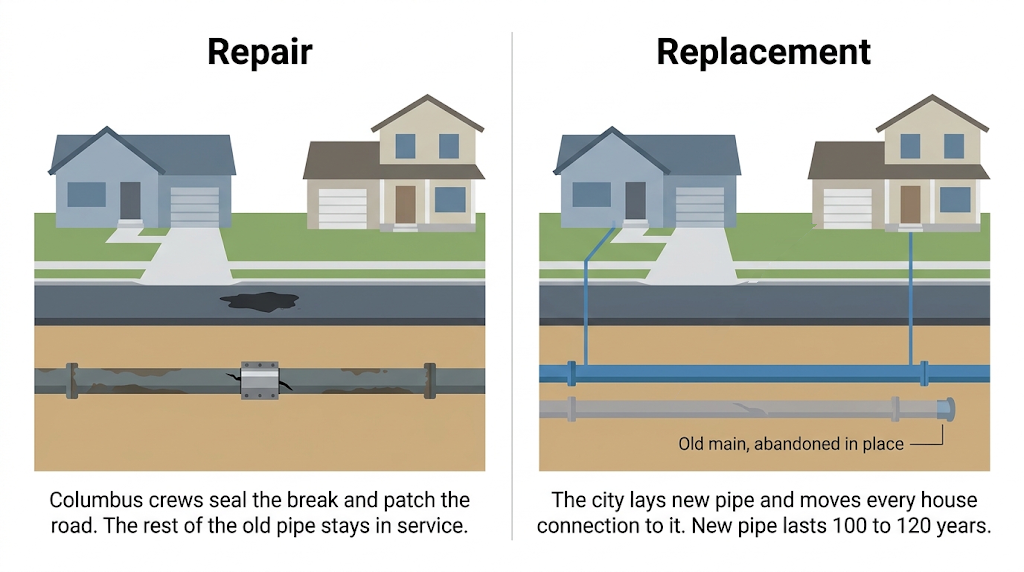
A repair fixes one break; a replacement swaps out a whole stretch of main. Illustration by Worthington Pulse.
Under the city's water contract, Columbus crews repair main breaks as they happen, and Worthington pays for some of those repairs under a formula in the contract. Staff's memo says 17 of the city's 35 breaks in 2025 were beyond what Columbus covers; repairing them cost about $331,000 against $200,000 budgeted, so an ordinance on the Nov. 16 agenda adds $140,000 (meeting packet, pp. 13-14). Replacing a main is the city's job, and that is what the capital plan pays for. On Nov. 2, staff told council why water lines are now replaced every other year instead of every year; the Pulse covered that discussion in its capital plan story.
The rate study
The proposed budget adds consultant money in Service and Engineering "to fund a water and sewer rate study," which the budget letter says "will inform consideration of an increase in the surcharge rate to help fund additional investments." The budget sets no new rate, and the forecast holds surcharge revenue at $45,000 a year each for water and sewer through 2028 (pp. 13, 23, 30). Council members' views on the surcharge at the Oct. 12 budget session are in the Pulse's First Look at the 2027 Budget.
More from this special edition: