Hello Worthington! The city's proposed 2027 operating budget and its 2027-2031 capital improvements program arrived together in one 180-page PDF document. It sets what the city spends in 2027 on police, fire, parks, trash pickup, and everything else, and it maps five years of street, water line, sewer, trail, and building projects. City Council has been working through it in pieces since early October.
This special edition walks through what is in the document, with sub-articles (linked below) for deeper dives on capital project year by year, the water and sewer math, and what the city owes. The full proposed budget is a PDF on the city's website. Page references below use the printed page numbers in that document, and each one links directly to its page of the PDF.
The big picture
The general fund, which pays for day-to-day city services, would spend about $45.7 million in 2027, up 4.7% from the 2026 budget. Changes staff proposed on Nov. 10 add about $242,000 more, mostly for curbside composting. The budget letter says the budget holds services steady and adds no staff positions. The chart's 2027 spending bar, $45.8 million, also counts about $141,000 the forecast sets aside for additional appropriations (pp. 7, 26, 29; meeting packet, pp. 55-56).
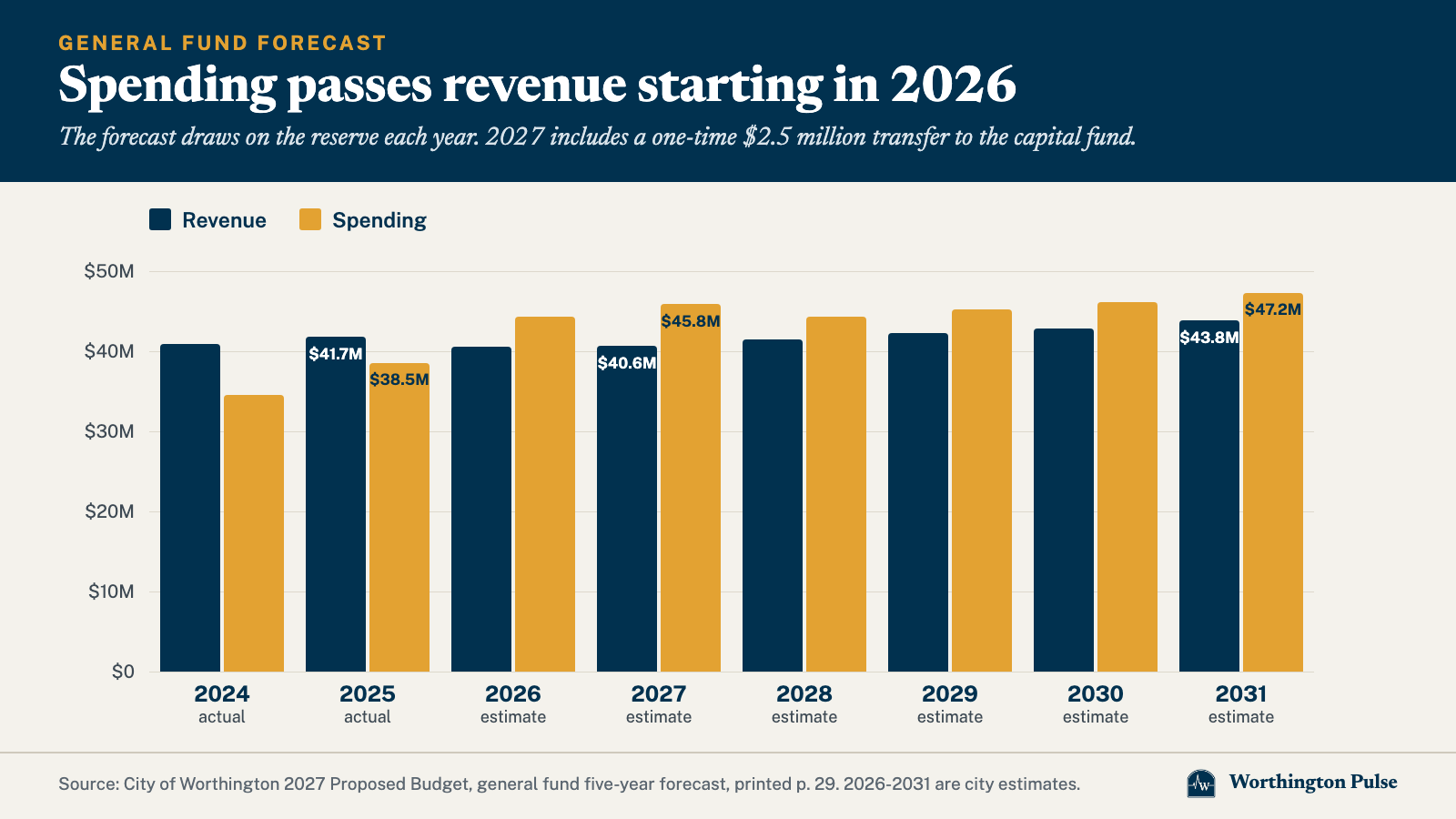
The city's general fund spends more than it takes in every year from 2026 through 2031, by its own forecast. Source: 2027 Proposed Budget, p. 29.
Revenue is flat. Income tax pays for about 70% of the general fund, which expects about $28 million from it in 2027 (about $35 million in all, counting the share that goes to capital projects), still below what it collected in 2025. Bartter told council on Nov. 9 that collections through October were flat compared with 2025. Worthington Steel, one of the city's three largest income tax payers, leaves in early 2027. Interest earnings are falling too, while wages and health insurance costs rise (pp. 8, 19, 29, 30; Nov. 9 recap).
The forecast shows spending above revenue every year from 2026 through 2031; 2027 includes a one-time $2.5 million transfer to the capital fund. Its reserve falls from about $33.6 million at the end of 2025 to about $19.3 million in 2031, but stays above the city's minimum of 35% of a year's spending, and the budget letter says the trend "will be monitored" (pp. 7, 11, 29).
Council's Oct. 12 and Oct. 19 sessions covered how staff presented these numbers and what council members asked: First Look at the 2027 Budget and Department by Department.
Changes that reach households
Most of the budget keeps existing services running. A few changes reach households directly:
- Trash, recycling, and yard waste. The new collection contract with Local Waste Services starts Jan. 1, 2027, and costs 16% more per household than the current one. The city's budget pays the increase (p. 10). Details are in the Pulse's story on the 2027-2032 waste contract.
- Curbside composting. Council approved food-waste pickup in a 4-3 vote on Oct. 19, and staff's Nov. 10 changes add $200,000 to pay for it (meeting packet, p. 55). Collection starts Jan. 1, and households must sign up to get it.
- Community Center and Griswold memberships. Under the fee schedule council adopted in 2024, membership rates are expected to rise about 6% in 2027 (p. 21).
- Property tax. The city's share of the property tax bill is about 5.92 mills, including the 0.92 mill that repays the voter-approved outdoor pool bonds. The county's 2026 property value update is expected to raise the city's property tax collections about 10.8% in 2027 (p. 20).
- The outdoor pool. Construction began in early 2026, and the pool is set to open for the 2027 summer season, run by Swiminc under a lease. On Nov. 9, Director of Service and Engineering John Moorehead told council it remains "on schedule and on budget" (p. 7; Nov. 9 recap).
- Deer management. The program's second year runs December 2026 through February 2027, possibly into March, and its budget rises from $75,000 to $100,000 for a higher removal target and a longer season (pp. 6, 30).
- Water and sewer. The water and sewer surcharge on Columbus water bills, unchanged since 1958, stays the same in 2027. The budget pays for a rate study to inform how much it should be (p. 10).
The budget also pays for two one-time costs residents won't see directly: $275,000 to review and rewrite the zoning code to match the Worthington Together comprehensive plan, and $275,000 for the city's share of new software at the regional 911 center in Dublin that answers Worthington's calls. Staff's Nov. 10 changes add about $109,000 more for the dispatch center (pp. 9, 10; meeting packet, p. 55).
Stay connected to what's happening in Worthington, Ohio.
Not funded, or not yet funded
The document lists several things it leaves unfunded, or that depend on money the city does not have yet:
- A sustainability plan. Council's policy agenda includes a Sustainability Action Plan, but the budget letter says developing one would take more community engagement, analysis, and resources, and Stewart told council on Nov. 9 that the 2027 budget has no money for it (p. 7; Nov. 9 recap).
- Housing programs. The 2026 budget set aside $500,000 for housing programs that "have not yet been identified," and the 2027 budget adds nothing to that line. Discussions about how to use the money are expected after the comprehensive plan is adopted (pp. 5, 26).
- Selby Shelter House. Construction in 2028 is budgeted at $1.2 million: $850,000 from the city and $350,000 from a source that "has not yet been identified," such as sponsorships or grants through the Parks and Recreation Foundation (p. 14).
- Skate park. The 2029 replacement is budgeted at $390,000. The city would pay half, with the rest expected through a partnership with the Parks and Recreation Foundation, and the capital plan notes that a full replacement would need more grants or donations (pp. 14, 100, 114).
- Trails and paths that depend on grants. Replacing the two Olentangy Trail bridges relies on regional federal funding the city has applied for, and the Route 161 shared-use path from Farrington Drive to Route 315 depends on state safety funding the city has applied for; both applications are under review (pp. 12, 13).
- More water line replacement. The plan replaces three water lines over five years. The budget letter says it "would be beneficial to complete more projects, however funding is insufficient to do so" (p. 13).
Staffing
The budget letter says the proposed budget adds no positions overall. It drops a vacant human resources position and adds a project engineer in Service and Engineering, because the number of capital projects "is outpacing the capacity of staff to manage them." Staff's Nov. 10 changes would eliminate that engineering position, along with a part-time police evidence technician, to help pay for curbside composting, as proposed during the Nov. 2 meeting (capital plan story). Three firefighters first hired with a federal grant stay on the payroll now that the grant has ended, because the overtime they save is greater than what they cost in pay and benefits (pp. 9, 11; meeting packet, p. 56).
Five years of capital projects
The 2027-2031 capital improvements program is the city's plan for streets, water and sewer lines, buildings, parks, trails, and equipment. Counted the way the city's capital fund tracks it, it spends about $62.7 million over five years, including debt payments, and the budget letter calls the fund "very constrained" (pp. 12, 129).
That is the reason for the one-time $2.5 million transfer from the general fund. Three projects, the East Wilson Bridge Road shared-use path, the sidewalk gaps program, and a new Olentangy Trail crossing at Route 315 and Route 161, are paid for by COTA's LinkUS program, which reimburses the city only after it spends the money. The transfer gives the capital fund the cash to build them and wait for repayment (p. 12).
Counting every funding source, project spending peaks in 2029 at about $15 million, when the East Wilson Bridge path is built. The biggest categories are streets and arterial roads, water and sewer lines, and bike and pedestrian projects (pp. 98, 109-116).
Stay connected to what's happening in Worthington, Ohio.
Water and sewer
Worthington's water and sewer surcharge is 75 cents for every 1,000 cubic feet of water a household uses, billed on its Columbus water bill. It has not changed since 1958, raises roughly $80,000 a year, and does not fully cover the cost of maintaining the lines. The capital plan puts about $11.3 million into water lines and the Kenyon Brook sewer over five years, and the budget pays for a rate study to inform what the fee should be. Staff's Nov. 10 changes add a one-time $150,000 transfer to the water fund for 2027 (pp. 10, 23; meeting packet, p. 55).
Debt
The city owes about $29.1 million in existing bonds and loans as of Jan. 1, 2027, led by the voter-approved outdoor pool bonds. The capital plan would borrow about $17.7 million more for seven projects: three water lines, the Kenyon Brook sewer, road repaving, and heating and cooling systems in city buildings. The capital fund's yearly debt payments rise from about $1.1 million in 2027 to about $2.9 million in 2031 (pp. 107, 108, 129).
How to weigh in
- Read the budget in the proposed budget PDF. The table of contents is on p. 16.
- Try the city's "Balancing Act" tool, which lets residents try their own mix of spending and revenue, on the city's budget page, along with budget presentations and videos.
- Email council at council@worthington.org, or speak at the Dec. 7 public hearing.
Upcoming Dates
- Monday, Nov. 16, 7 p.m.: Council follows up on open budget questions, and the 2027 budget ordinance is introduced with its dollar amounts left blank, to be filled in for the public hearing (meeting packet, p. 31).
- Monday, Dec. 7: Public hearing on the budget and on a resolution accepting the 2027-2031 capital plan (p. 17). City Manager Robyn Stewart said Nov. 9 that council votes on both that night (Nov. 9 story).
Thanks for reading this special edition. The Pulse's ongoing coverage of city finances is collected under the Budget tag.