This article is part of a Worthington Pulse special edition on the city's proposed 2027 budget. Start with What's in Worthington's 2027 Proposed Budget, which links the full series.
Worthington will owe about $29.1 million in bonds and loans at the start of 2027, and its proposed 2027-2031 capital plan would borrow about $17.7 million more for water lines, a sewer, road repaving, and heating and cooling systems in city buildings. The budget document says the city "has a number of years before additional debt will be paid off, so the City's payments for debt will only increase during the timeframe of the proposed CIP and beyond" (pp. 106, 107, 108).
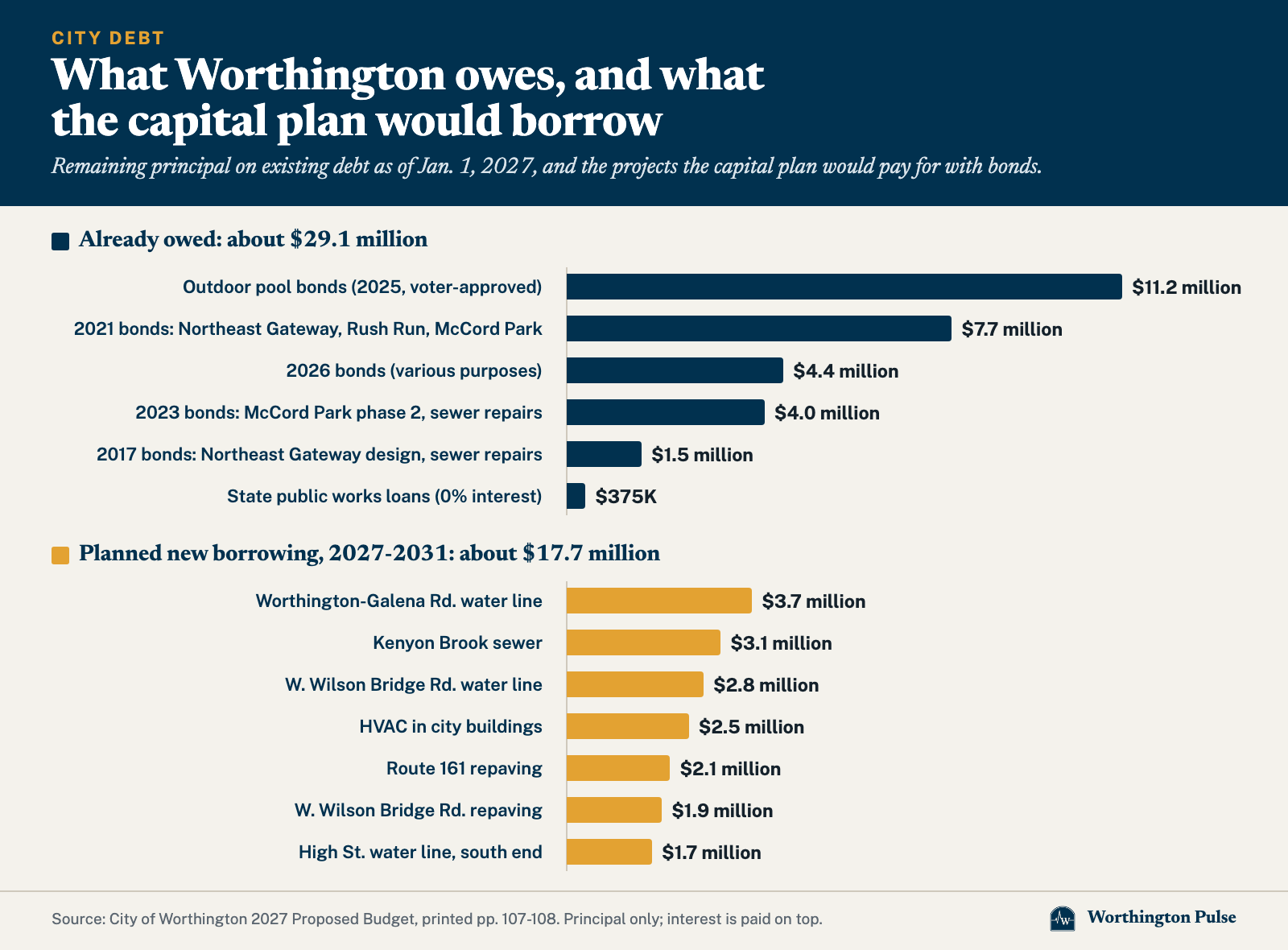
What the city already owes, and what the proposed capital plan would add. Source: 2027 Proposed Budget, pp. 107-108.
What the city owes as of 2027
Worthington carried very little debt before 2000. It borrowed in the early 2000s to expand the Community Center and renovate a building for the police division, paid that off in 2021, and has borrowed more regularly in recent years (p. 106). The balances remaining on Jan. 1, 2027 (pp. 107-108):
- Outdoor pool bonds, about $11.2 million. Voters approved these in November 2024. They are repaid through about 0.92 mill of property tax (p. 20), and the 2027 payment is $370,000 of principal plus about $523,000 of interest (p. 108).
- 2021 bonds, about $7.7 million, for the Northeast Gateway, Rush Run improvements, and McCord Park, paid off by 2041.
- 2026 bonds, about $4.4 million, issued in 2026, paid off by 2046.
- 2023 bonds, about $4 million, for McCord Park's second phase and sewer repairs, paid off by 2043.
- 2017 bonds, about $1.5 million, for Northeast Gateway design and sewer repairs, paid off in 2031.
- Two zero-interest state public works loans, about $375,000, one for curb ramps that ends in 2028 and one for earlier Kenyon Brook sewer work that runs to 2045.
New borrowing and debt payments
The capital plan would finance seven projects with bonds, about $17.7 million in all, borrowed in 2027, 2029, and 2031; the chart above lists them. The budget letter cites a larger figure, about $19.3 million, because it also counts two projects carried over from the 2026 plan, the Caren Avenue water line and Olentangy Trail maintenance (pp. 12, 14, 108, 127).
The capital fund's yearly payments on city debt rise from about $1.1 million in 2027 to about $2.9 million in 2031. For 2027 and 2028, money already in the city's bond repayment fund covers the interest, so the capital fund pays only principal; full payments resume in 2029. The voter-approved pool bonds are repaid from their own property tax rather than from the capital fund. Debt per resident, $547 in 2017, is projected to reach $2,013 by 2031 (pp. 12, 106, 129).
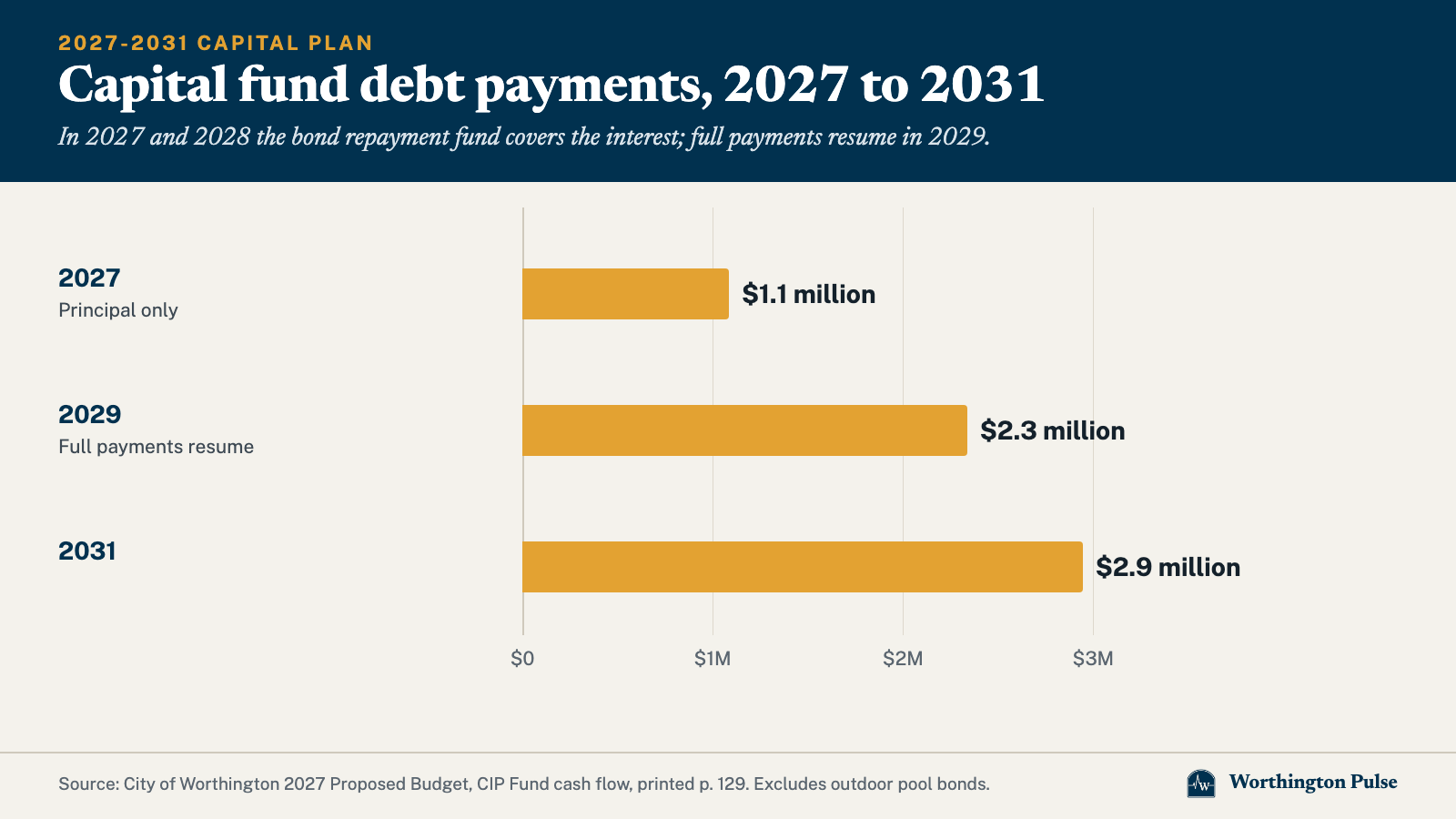
The capital fund's debt payments rise in 2029, when full payments resume.
The city's debt policy, adopted in 2018, calls for keeping at least 10% of its unvoted borrowing capacity in reserve for emergencies, limits a bond's term to the useful life of what it pays for, and commits the city to "use its best efforts to maintain its current 'AAA' rating." Standard & Poor's gave the city that rating in 2026 (pp. 47, 131, 132).
Stay connected to what's happening in Worthington, Ohio.
The capital fund's balance
The capital fund keeps a cash balance because income tax revenue flows in throughout the year, and the city needs cash on hand to start projects and to handle unexpected problems with infrastructure or equipment. Leaving out bonds and bond-funded projects, the balance is projected to fall from about $8.5 million at the end of 2027 to about $2.8 million in 2031. The 2027 figure includes the one-time $2.5 million general fund transfer that fronts the cost of LinkUS projects. The cash flow sheet draws a line at half a year's spending; the projected balance is below it in 2029 and 2031 and just short of it in 2030. The city has no adopted policy for this fund's balance, and the plan's own summary says "steps to increase revenue or decrease expenditures need to be considered" (pp. 12, 15, 97, 104, 129).
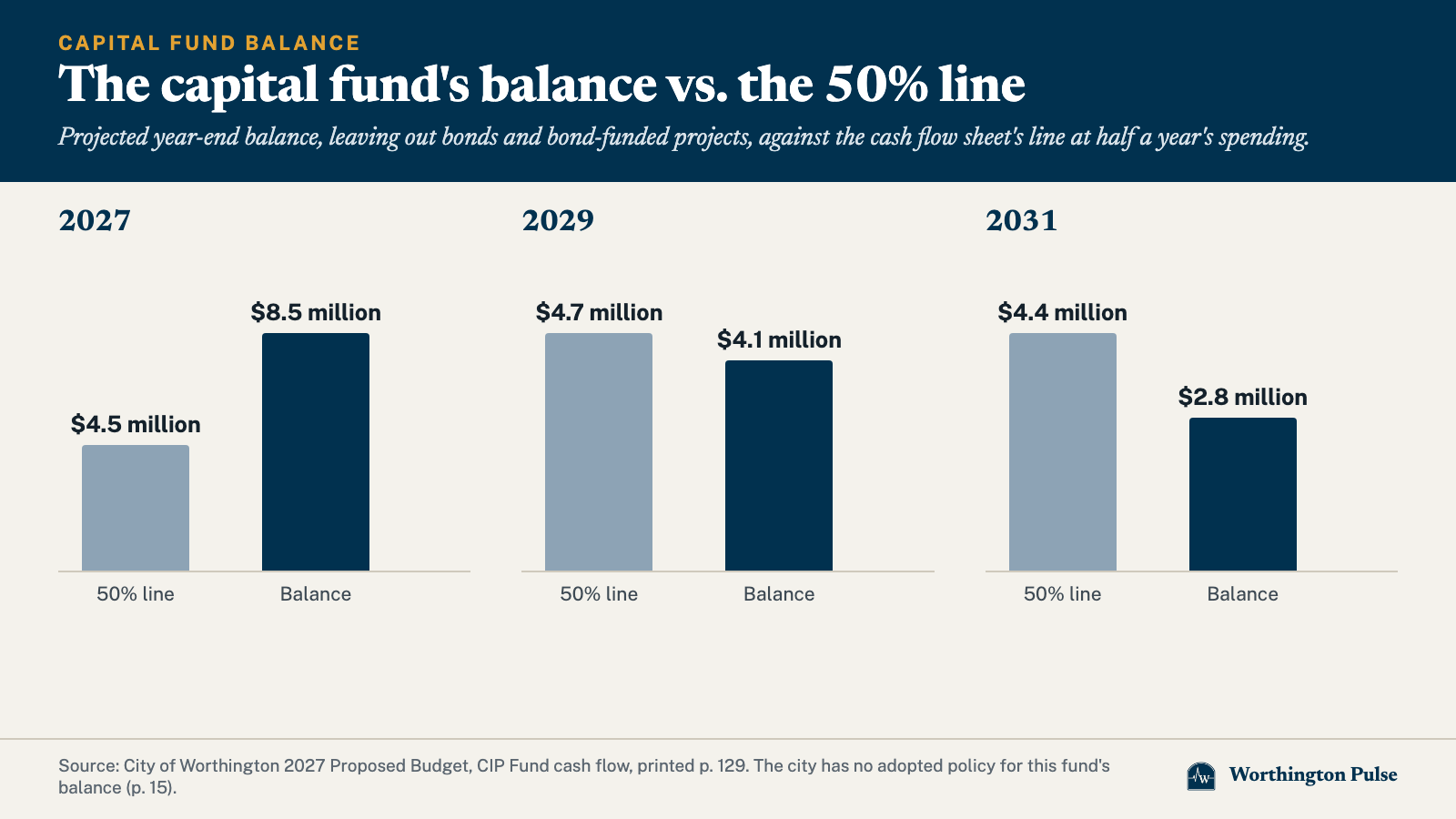
The balance is well above the 50% line in 2027 and below it in 2029 and 2031.
The general fund's reserve and interest income
The general fund, which pays for day-to-day services, does have a policy: its unencumbered reserve must stay at or above 35% of the previous year's spending. The forecast keeps it above that line every year, at 55% at the end of 2027 and 42% in 2031, as the city draws down about $14 million of reserve over six years to cover the gap between revenue and spending. (The budget letter cites 58% for 2027, which matches the forecast's cash-balance line.) (pp. 11, 29, 134).
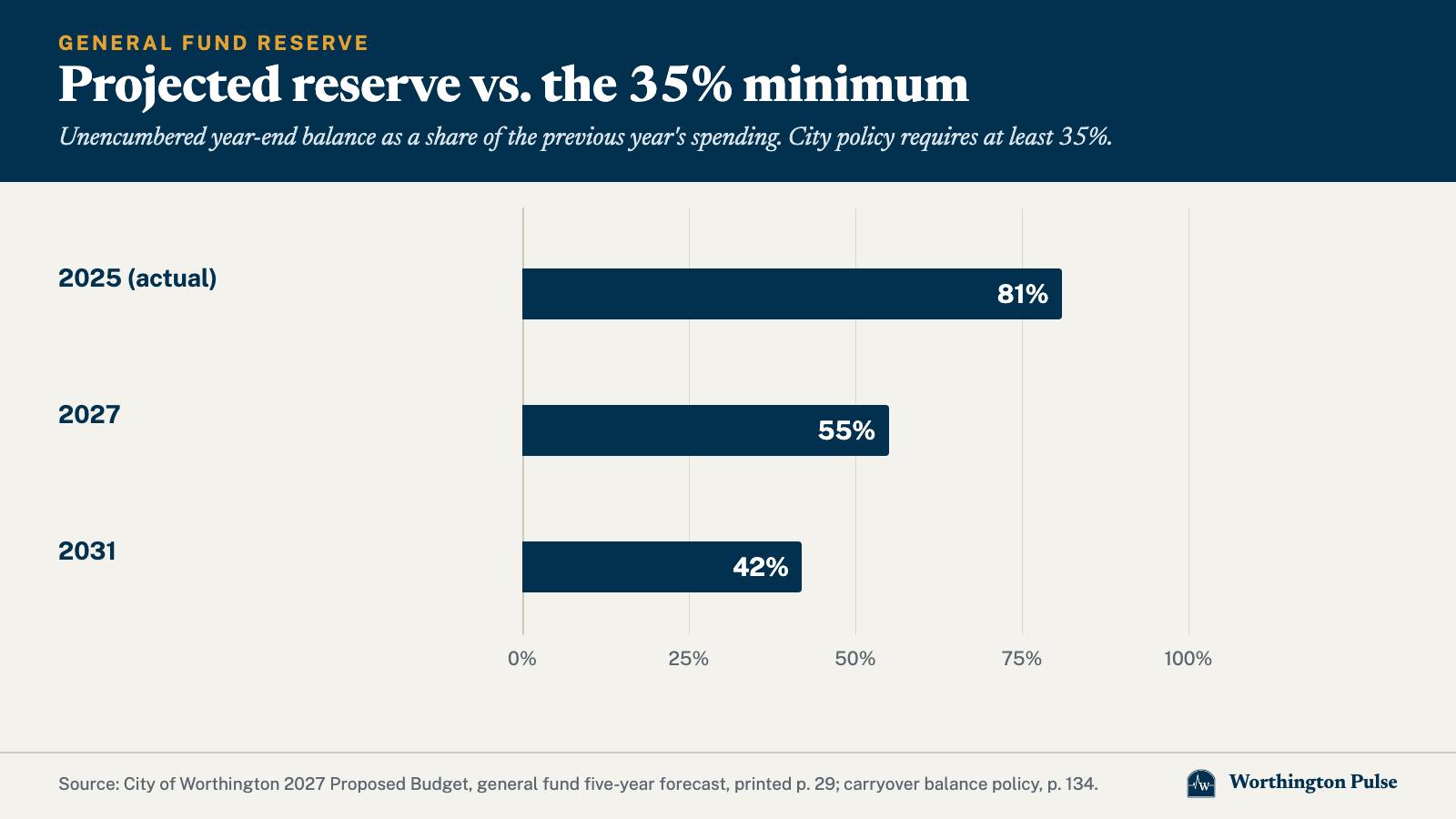
The projected reserve stays above the policy minimum through 2031.
If the reserve did slip below 35%, the policy sets out what happens next (pp. 134-135):
- Between 25% and 35%: the city trims spending during the budget process.
- Between 15% and 25%: it reviews fees, looks for new revenue, and freezes hiring for general fund positions, with some exceptions.
- Below 15%: it discusses "revenue enhancements, tax levies, and reductions in programs and personnel."
- Above 50%: the city manager schedules a discussion with council about using part of the reserve for one-time spending that would benefit the community.
Interest income is falling too: about $2.3 million in 2025, a forecast $850,000 a year from 2027, and $500,000 a year by 2030, as interest rates and the amount of cash the city has invested come down (pp. 8, 29).
Council discussed the debt and the AAA rating with staff on Nov. 2, covered in the Pulse's capital plan story.
More from this special edition: