This story is part of Worthington Pulse's coverage of the November 2 City Council meeting. Start with the November 2 meeting recap.
On Nov. 2, City Council got its first walk-through of the city's proposed capital improvements program for 2027 through 2031: about $62 million over five years for streets, water and sewer lines, buildings, parks, trails, and equipment. That is less than last year's roughly $70 million plan, which included the new outdoor pool, but the city is paying for more of it with borrowed money, and the money left in the capital fund falls from 95% of a year's spending in 2027 to about 32% by 2031. City Manager Robyn Stewart also proposed a way to pay for the curbside composting council approved on Oct. 19 but never funded: eliminate two positions the city has not filled.
Assistant City Manager David McCorkle presented the plan with Stewart and Finance Director Scott Bartter. Council takes up follow-up questions Nov. 16 and votes on the budget and capital plan Dec. 7.
Where the money comes from
Income tax pays for more than half of the capital plan; 20% of the city's income tax goes to it each year. McCorkle said income tax collections have tightened and are shown flat for the full five years, in part because Worthington Steel "will be leaving us in early 2027."
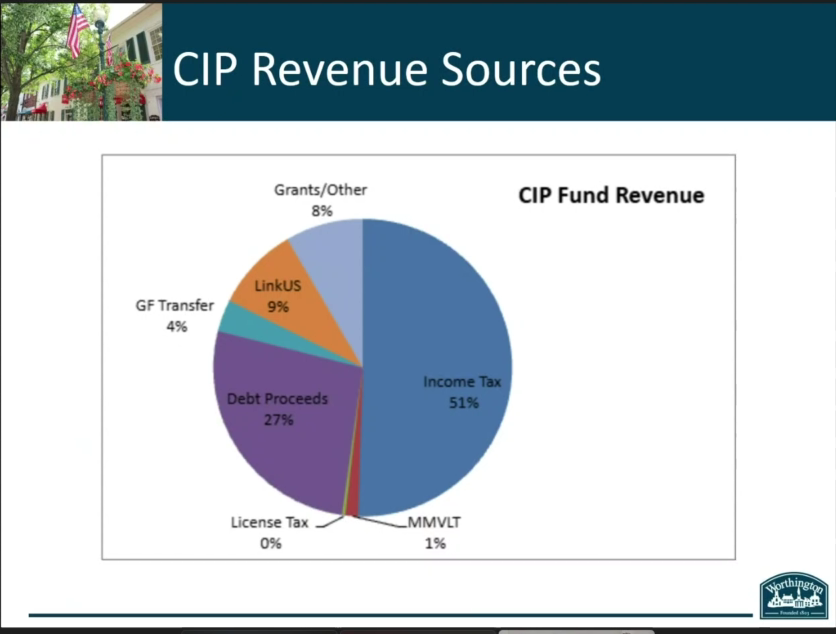 Assistant City Manager David McCorkle showed where the five-year capital plan's money comes from. From the video at 1:20:48.
Borrowed money now covers more than a quarter of the plan. The city also expects more outside money than in past years: reimbursements from LinkUS, the regional transit and trail program led by COTA, plus state transportation (ODOT) grants. Historically, the city pays 90% or more of the plan's cost itself; that share dips in 2029, when an ODOT-funded shared-use path along Route 161 is scheduled. McCorkle said that project is in the plan only if the grant comes through. "If the ODOT grant funding doesn't happen, the project doesn't happen."
The proposed budget moves $2.5 million from the general fund into the capital fund in 2027. Last year's plan moved $500,000 a year. McCorkle said the total is the same over five years but front-loaded, because LinkUS pays the city back only after it spends the money, so the city needs the cash up front.
More debt, and a shrinking cushion
The plan calls for about $18 million in new borrowing for seven projects, with bonds issued in 2027, 2029, and 2031. At a council member's request, McCorkle confirmed that the $18 million is additional debt, on top of what the city already owes. Bartter put the current figure at "about 30 million right now, and this is issuing another 18." The city's yearly debt payments rise from about $1.1 million in 2027 to almost $3 million by 2031.
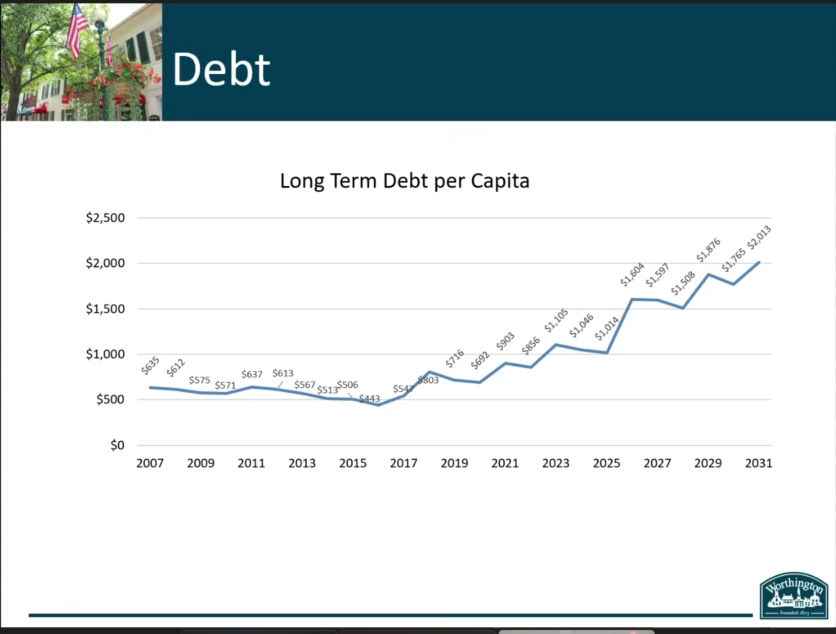 Worthington's long-term debt per resident has climbed since 2017 and is projected to pass $2,000 by 2031.
McCorkle said the city carried very little debt before 2000. Debt per resident was about $550 in 2017, will be about $1,600 in 2027, and will pass $2,000 by 2031. Asked by a council member whether that much borrowing threatens the city's top AAA bond rating, Bartter said it should not, and the city has room under its legal limit, "but it is issuing a lot of debt."
Stewart said tighter revenue and aging infrastructure have pushed the city toward borrowing for long-lived assets like streets and water lines, which spreads their cost over the years residents use them. "We are starting to be squeezed more" by the payments, she said. Staff spread out some bonded projects and shifted others to cash to keep the payments in check.
Expenses outpace revenue in every year of the plan except 2027. Leaving out bonds and money dedicated to specific projects, the capital fund's balance falls from 95% of a year's spending in 2027 to about 32% in 2031. McCorkle called it "certainly worth monitoring."
Funding requests outran the money, McCorkle said. Nearly all the equipment in the plan replaces something the city already has, and many items have been pushed back once or several times. "Every year it really is a puzzle," he said.
Stay connected to what's happening in Worthington, Ohio.
How composting would be paid for
On Oct. 19, council voted 4-3 to add curbside food-waste collection starting Jan. 1, at about $207,000 a year, without deciding where the money would come from. Several members had pointed to capital projects such as the Selby Shelter House or the City Hall renovation.
Stewart steered away from that. "It's really not considered a best practice to take capital dollars or delay projects in the CIP to fund an ongoing program," she said. She wanted a recurring offset for a recurring cost, and proposed eliminating two positions in the proposed operating budget that are not filled:
- A project engineer. The proposed budget moves a vacant Personnel position to Service and Engineering to help manage the growing list of capital projects. Stewart said that after talking with City Engineer John Moorehead, losing it would limit how many federally funded projects the city can take on at once, and project work may have to be spread out over the five years.
- A part-time police evidence technician. The police division had planned to split evidence duties out of a full-time position into a new part-time job.
Asked whether the two positions would cover the program each year, Stewart said she believes they are equivalent to its cost, and because they are recurring positions the savings would carry through each year. Council does not have to decide yet; Stewart asked for direction before the budget is adopted in December. Staff's list of budget changes for the Nov. 16 meeting adds $200,000 for composting and eliminates both positions; council votes Dec. 7.
Water main breaks, and why lines are replaced every other year
The plan replaces water lines every other year instead of every year, McCorkle said, until a water and sewer rate study shows where the money will come from. The proposed operating budget pays for the study. Stewart said staff could not fit annual replacement into the plan with the money available. Asked whether the city could return to every year once the study is done, she said that is the goal.
By the numbers:
- 35 water main breaks in 2025. Columbus covers the repair cost for a set number each year, which for 2025 was 18; Worthington pays for the rest.
- About $331,000 in total for those 17 extra repairs, against $200,000 budgeted. One of the spending ordinances introduced Nov. 2 (Ordinance 36-2026, public hearing Nov 16) covers the difference, and staff plans to raise the 2027 repair budget before council adopts it.
Moorehead said that much of Worthington was built in a roughly 20-year burst around the 1960s, so a lot of infrastructure will reach the end of its life at about the same time.
Ready for another bad winter?
Council Member Joycelyn Dong asked whether the city is prepared for another winter of breaks like the last one. Council Member Rebecca Hermann recalled that by the end of March the city had already had as many breaks as in all of 2025. Moorehead said many of last winter's breaks were tied to unusually cold weather and the effects may linger at least through this winter. Breaks track the age of the pipe, he said, and the city is replacing old mains "at the pace which we can afford currently." Dong restated it in plain terms: "Ideally we would be paying to replace water lines every year, but we cannot afford it."
Stewart said the city may rerun the study it uses to rank which lines to replace, because some lines that were not high on the list have started breaking.
What's in the plan for 2027
Every project, year by year, is in the Pulse's Street by Street.
The only project in the plan the city is legally required to do is the Kenyon Brook sewer project, which should be finished during these five years. Other highlights for 2027 and beyond:
- City buildings
- HVAC replacement, phases two and three. Moorehead said this replaces failing systems and has no guaranteed energy savings, unlike an earlier efficiency program.
- City Hall: first-floor security changes, council chambers upgrades, and an elevator.
- Community Center: locker rooms, pool, elevator, lobby, and air handler.
- McConnell Arts Center roof.
- Parks
- New playgrounds at Linworth Road Park and Pingree Park.
- Court resurfacing and Perry Park ball field lighting.
- Design of the Selby Shelter House renovation in 2027.
- Skate park replacement.
- Bike and pedestrian
- $50,000 in each of 2027 and 2028 for general improvements.
- With LinkUS money: a shared-use path on East Wilson Bridge Road, a sidewalk gap program, and a better Olentangy Trail connection at Route 315.
- The Route 161 shared-use path, if the ODOT grant comes through.
- Replacement of the Olentangy Trail bridges, which depends on regional funding in 2031.
- Council priorities: the sidewalk gap program, and money in 2027 through 2029 for wayfinding and branding of Forge Fields at Rush Run, the northeast business corridor.
- Equipment: police cruisers, in-car and body-worn cameras, computers and network equipment, a new timekeeping system, and routine fire and parks equipment, timed with advice from the city's fleet manager.
The plan also includes a public Wi-Fi mesh network for the central business district. A council member said businesses and residents in Old Worthington complain about phone and data service; McCorkle said the project is public Wi-Fi only and won't change cell service. He said it ties into fiber the City of Hilliard ran under High Street a couple of years ago, some of which Hilliard provides to Worthington at no cost.
Correction (Nov. 16, 2026): An earlier version of this story said the borrowing comes in seven bond issues, one or two a year. The proposed budget borrows for seven projects in three issues, in 2027, 2029, and 2031.
This is one of 2 Worthington Pulse stories from the November 2 city council meeting recap. The budget document itself is covered in the Pulse's special edition on the 2027 proposed budget.