
This story is part of Worthington Pulse's coverage of the Oct. 12 City Council meeting. Start with the Oct. 12 meeting recap.
City Council got its first look at the city's proposed 2027 operating budget Monday night, presented by City Manager Robyn Stewart and Finance Director Scott Bartter: a $2.5 million transfer to capital projects, a 4.72% increase in general-fund spending, and a council debate over whether the city is doing enough to catch up on decades of aging infrastructure. Council also weighed a trade-off between a new park shelter and adding food composting to trash pickup, and finally saw a water and sewer fee that hasn't moved since the 1950s get funding for the study that could raise it.
The Big Picture: Revenue, Spending, and a Five-Year Forecast
The city plans to spend 4.72% more from its general fund, its main operating account, in 2027 than it budgeted for 2026. The biggest increases are the $2.5 million transfer to capital projects, a higher refuse-collection contract, a vacant human-resources position moved into engineering to help manage a growing list of capital projects, and a one-time $275,000 charge from the regional dispatch center for upgrades to its system. About $3 million of next year's spending is one-time, including the capital transfer, the zoning code update, the dispatch charge and the water and sewer rate study.
Finance Director Scott Bartter told council that 71% of the budget goes to personal services, including pay and benefits, and that public safety alone, fire, police, and dispatch, accounts for 45% of spending, followed by parks and recreation at 17 percent.
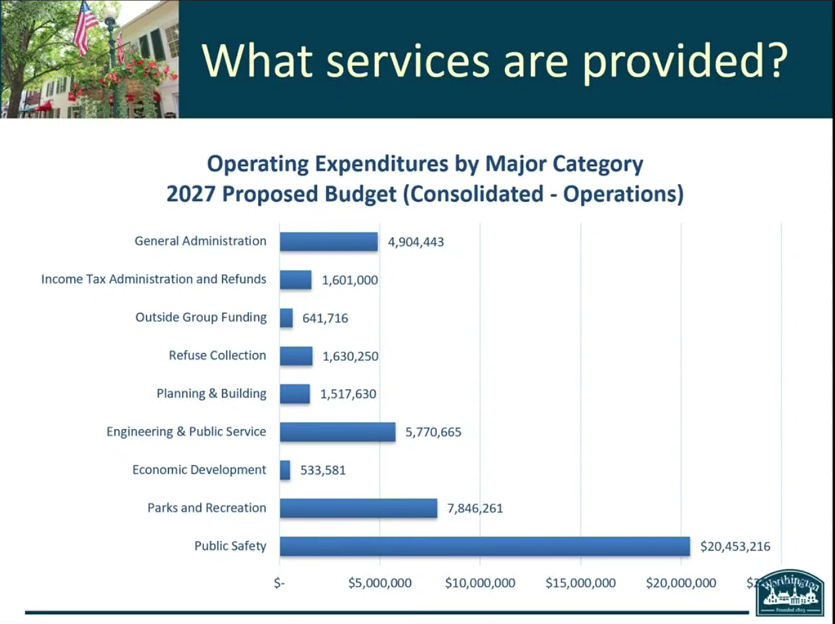 Public safety is the largest share of 2027 operating spending at $20.5 million, followed by parks and recreation at $7.8 million. From the video at 36:31.
Revenue comes mostly from taxes: 66% from income tax and 13% from property tax. The city's 2027 income tax estimate is about $35 million, a modest 1.45% increase, continuing a slowdown from the roughly 2% annual growth of the past few years, a sharp drop from 2021's 16% spike. Bartter also credited a 2010 voter-approved increase in the income tax rate, from 2% to 2.5%, as the single most impactful decision behind the city's current fund balance, which has grown from about $1 million in 2010 to a projected $33 million by the end of 2025.
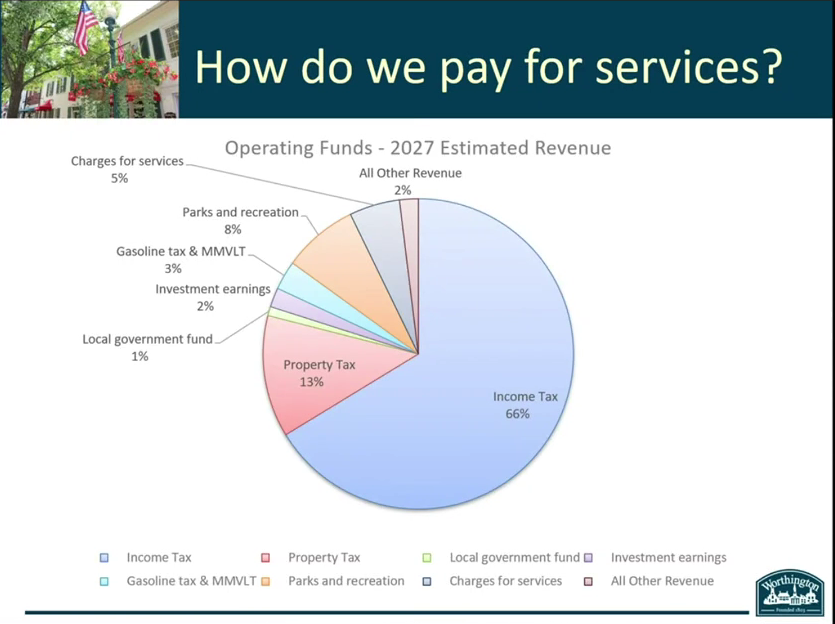 Income tax provides two-thirds of the city's 2027 operating revenue, and property tax another 13%. From the video at 41:56.
That strong fund balance is expected to decline over the next five years as the city resumes deficit spending, a trend accelerated by the $2.5 million capital transfer, though Bartter said the fund balance will stay above the city's target of 35% to 50% of the prior year's expenditures. The proposed budget also includes a 2.5% increase in grant funding for community groups, which will present their funding requests to council on Nov. 9, and smaller policy-agenda items including the second year of the deer management program and consulting help to rewrite the zoning code following the Worthington Together comprehensive plan.
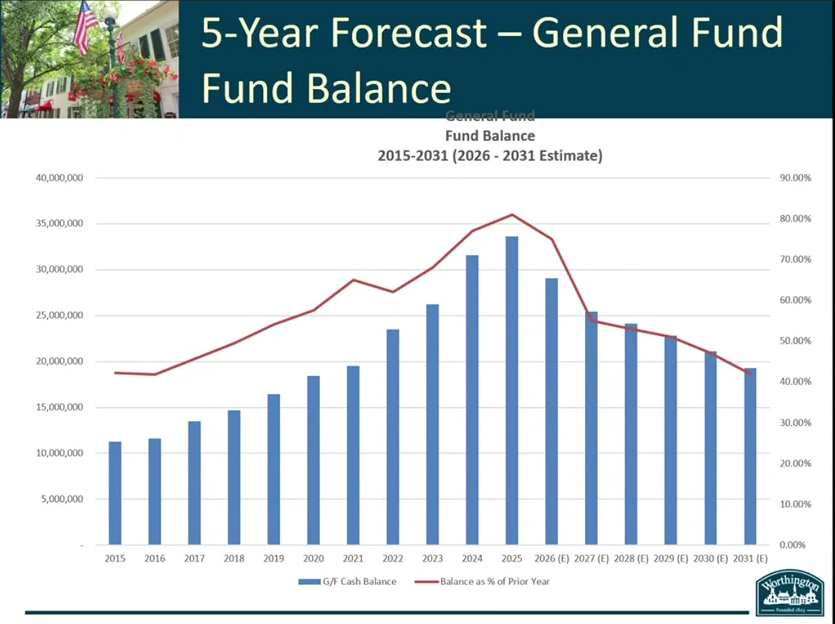 The city's general fund balance peaks in 2025, then declines each year through 2031 while staying above 35% of the prior year's spending (red line), the low end of the city's target. From the video at 45:46.
Council has three more sessions to dig into the budget before a vote: departmental budgets on Oct. 19, the 2027-2031 Capital Improvement Program on Nov. 2, and additional follow-up on Nov. 16, ahead of a public hearing and vote on Dec. 7. Residents can review and comment on the proposal using the city's "Balancing Act" budget tool, available on the city's budget page.
Is the City Catching Up on Aging Infrastructure?
Council Member Glen Pratt pressed staff on whether the proposed capital spending, the $2.5 million transfer plus one reallocated engineering position, is enough to make real progress against infrastructure built mostly in the 1960s and '70s, or whether the city needs a more aggressive approach. Stewart said some areas, particularly street and arterial maintenance, are gaining ground with more funding over the next five years than in recent years, while other areas are mainly holding steady.
City Engineer John Moorehead added that the city did little active investment in water and sanitary sewer infrastructure for roughly 20 years, a pattern that has only reversed in the past five to eight years. He said there isn't yet a comprehensive, citywide infrastructure study that could say definitively whether the city is ahead of or behind the curve, but the water and sewer rate study included in the proposed budget (see below) will project the system's future needs. Pratt put the stakes bluntly: "We can't afford 80 water line breaks next winter." Moorehead agreed that the rate of water-main breaks is one visible sign of aging infrastructure the city is tracking, and said council will hear more detail at the Nov. 2 capital-plan presentation.
Stay connected to what's happening in Worthington, Ohio.
Food Composting
Pratt also raised food composting, an item council is scheduled to revisit at its Oct. 19 meeting under a separate ordinance. Citing the budget's capital plan, Pratt floated delaying the Selby Shelter House project, budgeted at $125,000 for design and roughly $1.1 million for construction, both expected in 2028, to free up money for composting, contingent on the city's flat income tax trend improving.
Bartter and Stewart cautioned that the swap isn't as simple as it sounds: the shelter house is a one-time capital expense, while composting would be an ongoing operating cost that recurs every year, so freeing up capital funds now doesn't guarantee the city can sustain the service once that money runs out. Moorehead said Worthington's combined rate for trash, recycling, and yard waste would likely remain the lowest among communities served by the regional landfill authority even with composting added, in part because many neighboring cities bill residents directly for hauler fees that Worthington currently absorbs. Stewart noted the regional waste authority has offered capped grant funding to ease the city into the new service, but expects it to continue for at least five years after the grant runs out. Pratt said he accepted the financial constraint for now but wanted the trade-off on the record ahead of the Oct. 19 vote.
A Look at the Water and Sewer Surcharge
Council Member Joycelyn Dong asked for an update on a previously discussed fee on water bills. Stewart explained the proposed budget includes funding for a consultant to study the city's water and sewer system needs, a study meant to inform how much any new fee should be rather than set a number outright.
The surcharge in question, a flat 75-cent charge per 100 cubic feet of water used, hasn't changed since the 1950s and currently generates only about $45,000 for the water fund and $38,000 for the sewer fund, a fraction of what the city spends maintaining those systems. Council President Rachael Dorothy said she has pushed for an increase throughout her time on council, pointing to recent rate increases from Columbia Gas, AEP, and the city of Columbus. Moorehead clarified that those outside utilities' rate increases fund their own infrastructure, not Worthington's: Worthington's surcharge is the only mechanism that funds the city's own water and sewer system upkeep. Pratt said the data back up what he suspected, that Worthington's surcharge is "way below" what comparable central Ohio communities charge, and said he saw no reason to wait once the study comes back with a recommendation.
This story comes from the Oct. 12 meeting recap.