
This story is part of Worthington Pulse's coverage of the November 2 City Council meeting. Start with the November 2 meeting recap.
Worthington now has its own rules for e-bikes, e-scooters, and other small electric devices. City Council passed the amended ordinance (Ordinance 31-2026) on Nov. 2 after a final round of changes, and set every section to take effect on Feb. 1, 2027, so the city has time to stand up a rider safety class and tell families what is coming. The version that passed lowers the minimum riding age to 12 for Class 1 e-bikes and e-scooters, requires a safety course for younger riders, keeps an 8 mph speed limit on sidewalks, and puts the burden on riders to get safely around pedestrians.
Council had postponed its vote on Oct. 5 and asked staff to work several ideas into the text. Assistant Law Director Addison Spriggs walked council through what came back. The rider class at the center of the final version was the Bicycle and Pedestrian Advisory Board's idea, and council heard public comment on Oct. 5 and again Nov. 2.
Who can ride what
Riders must be at least 12 to use an e-scooter, another personal transportation device, or a Class 1 e-bike, the kind with a motor that only helps while the rider pedals. Class 2 e-bikes, which have a throttle, require riders to be at least 14, and Class 3 e-bikes at least 16, the state minimum. Minors may not carry passengers on a scooter or similar device, and children under 14 may ride as passengers on an e-bike built for passengers.
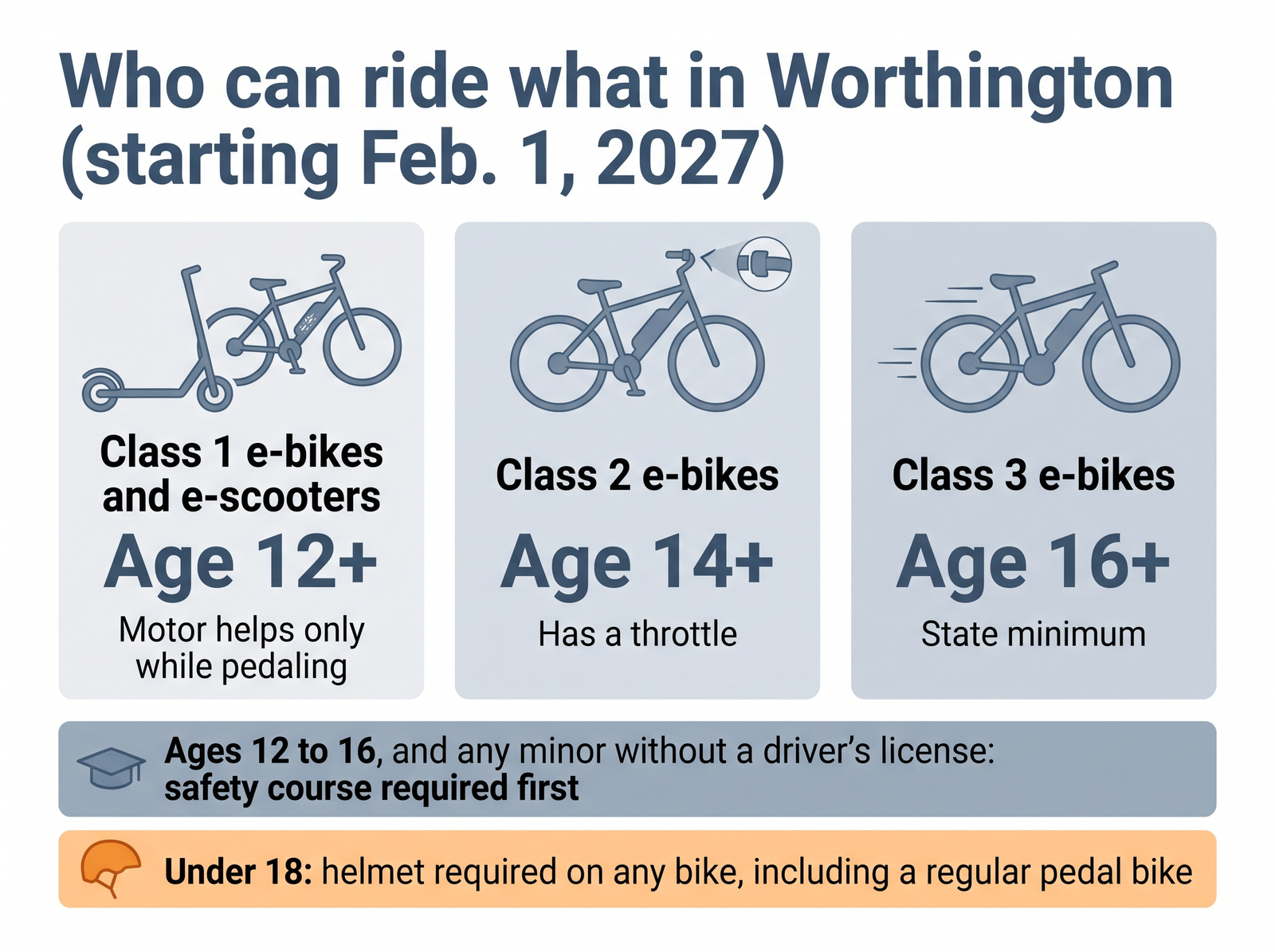 Who can ride what under the new ordinance. Source: Ordinance 31-2026 (As Amended).
Riders from 12 to 16 must complete a safety course, and so must any other minor who does not have a driver's license, Spriggs said. Asked whether that runs all the way to 18 for an unlicensed teen, Spriggs said it does. Spriggs said the Bicycle and Pedestrian Advisory Board heard the language at its Oct. 26 meeting and liked the idea of requiring the course for minors who "don't know the rules of the road" because they have no license or permit.
Starting Feb. 1, 2027, riders under 18 must wear a helmet on any bicycle, e-bike, or e-scooter, including an ordinary pedal bike; until now the city's helmet rule covered only mopeds. The helmet must carry a Consumer Product Safety Commission label and be worn with the chin strap fastened. A first violation carries a fine of up to $50, and the city will dismiss it if the rider shows proof of buying a helmet within 30 days.
One-wheels and similar devices count as personal transportation devices, a category the ordinance defines to include scooters, skateboards, and hoverboards.
Sidewalks and trails: slow down and yield
The least settled question in October was sidewalks. Council members had asked whether riders could be required to turn off the motor or get off and walk near pedestrians. Spriggs said staff concluded neither works as a rule. Some e-bikes keep a working throttle even with pedal assist set to zero, turning off the motor on others also shuts off the lights, some devices are too heavy to push, and some take several seconds to restart.
Instead, the ordinance keeps the 8 mph sidewalk speed limit and makes the rider responsible for getting around people safely. "That could be getting off and walking, that could be standing still and waiting for someone else to pass, that could be going into the street or the grass," Spriggs said.
On shared-use paths, the limit is 15 mph. E-bikes, scooters, and similar devices are not allowed on unpaved paths or trails in the city. Every bike and device must have a bell or similar signal audible from 100 feet, and riders must signal before passing a pedestrian, or call out if they have no bell.
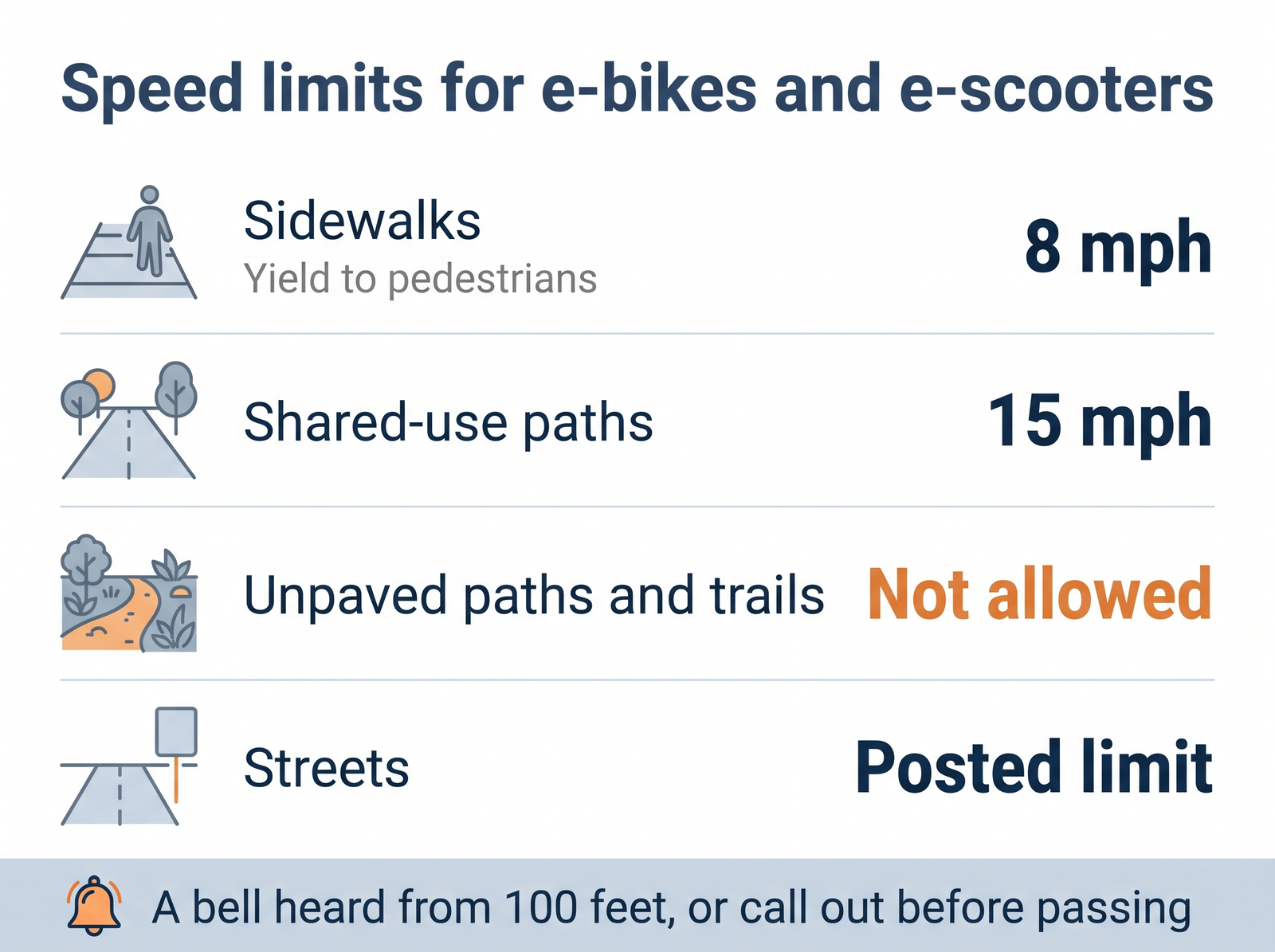 Where and how fast e-bikes and e-scooters may ride.
Council Member Glen Pratt said he would still prefer no e-bikes on sidewalks, "but I know I'm a minority on that". Council Member Maria Ramirez said the weight of the devices also puts pedestrians at greater risk, and asked the city to be ready to close some sidewalks to riding. "I want people to ride [e-bikes and scooters]. I think they're fantastic," she said. "But I wanna keep the pedestrians safe too."
City Manager Robyn Stewart said the code gives her the authority to designate places where riding is not allowed, and Old Worthington, with its sidewalk dining, is "definitely high on the list". She also described temporary signs for busy events on the Village Green such as the Arts Festival, with spots on the edges of an event where riders can lock up. She said she will draw up a list of locations and share it with council. Asked whether signs would also remind riders of the rules, as Bridge Park does on its pedestrian bridge, Stewart said the city would borrow wording that has worked in other communities.
Stay connected to what's happening in Worthington, Ohio.
A wider passing distance for drivers
The ordinance also asks something of drivers. At Council President Rachael Dorothy's request in October, staff wrote in a five-foot minimum passing distance when a driver overtakes a cyclist; state law sets three feet.
City Engineer John Moorehead showed council what that means on Worthington's narrowest streets. On Oxford Street, he said, leaving five feet beside a cyclist leaves about eight feet of pavement for a car, while the state's minimum lane width on a low-speed road is 10 feet. On some streets near the historic downtown, a driver "may not be able to pass a cyclist in compliance with the law". A second change exempts drivers passing a rider who is in a marked bike lane, such as the buffered green lane on Schrock Road, so cars don't have to straddle the next lane to give five feet.
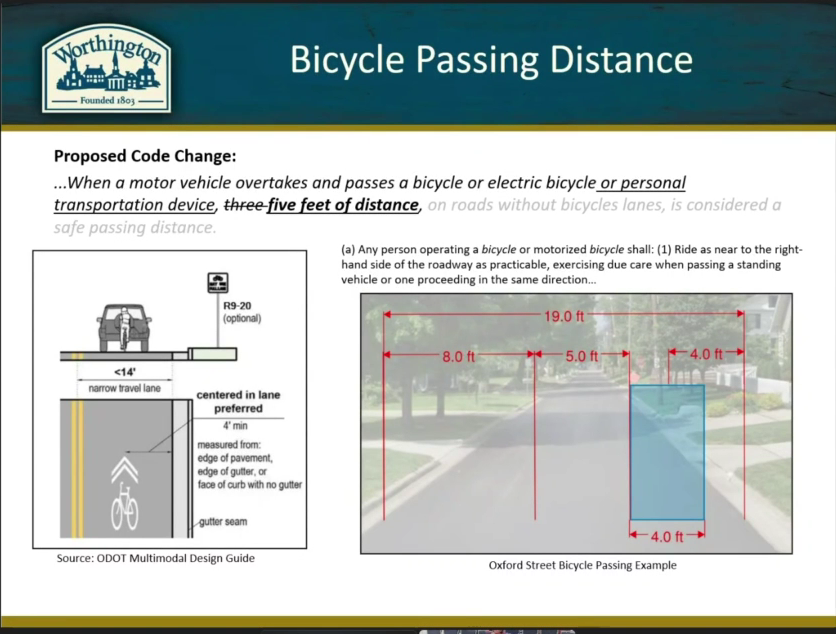 City Engineer John Moorehead showed how a five-foot passing buffer plays out on Oxford Street, one of the city's narrowest roads. From the video at 25:08.
Spriggs said the city could post no-passing signs on streets where safe passing isn't possible. Dorothy said the point is to protect the most vulnerable people on the road, and that "in practicality this can be very doable".
Why Feb. 1
Stewart said the safety class probably won't be ready until after the first of the year, which could leave young riders unable to ride legally for a couple of months if the ordinance took effect on the usual schedule. Pratt argued for one start date for everything so the public isn't confused by rules that phase in, and Stewart suggested Feb. 1 rather than Jan. 1 to avoid the holidays.
Law Director Tom Lindsey wrote the amendment during the meeting, adding a section that delays the rules until Feb. 1, 2027. The ordinance itself takes effect Nov. 25 on the normal schedule; only the rules wait. Stewart said sign-ups and possibly the class itself will likely run through Parks and Recreation. Later in the meeting she said the class will be paid for from the operating budget, not the capital plan, and that staff expects to propose a fee that may not cover the full cost.
Ramirez asked for public education before the holidays, while parents are deciding what to buy, so "they don't buy the wrong thing". She asked for a gift-buying guide the week before Thanksgiving. Council members also asked staff to time a helmet program with the class, either through a grant or with the city buying helmets itself, and Stewart said staff will look at what helmet incentives the city could offer.
Enforcement: education first
Asked by Dorothy how the helmet and speed rules would be enforced, Interim Police Chief Jeff Kubasek said officers will be learning along with everyone else, and that stops involving 12- to 16-year-olds will mean calling parents. "We're not going to be writing a whole lot of citations to children," he said. Officers already write far more warnings than tickets for drivers, he said, and would treat bikes and scooters the same way.
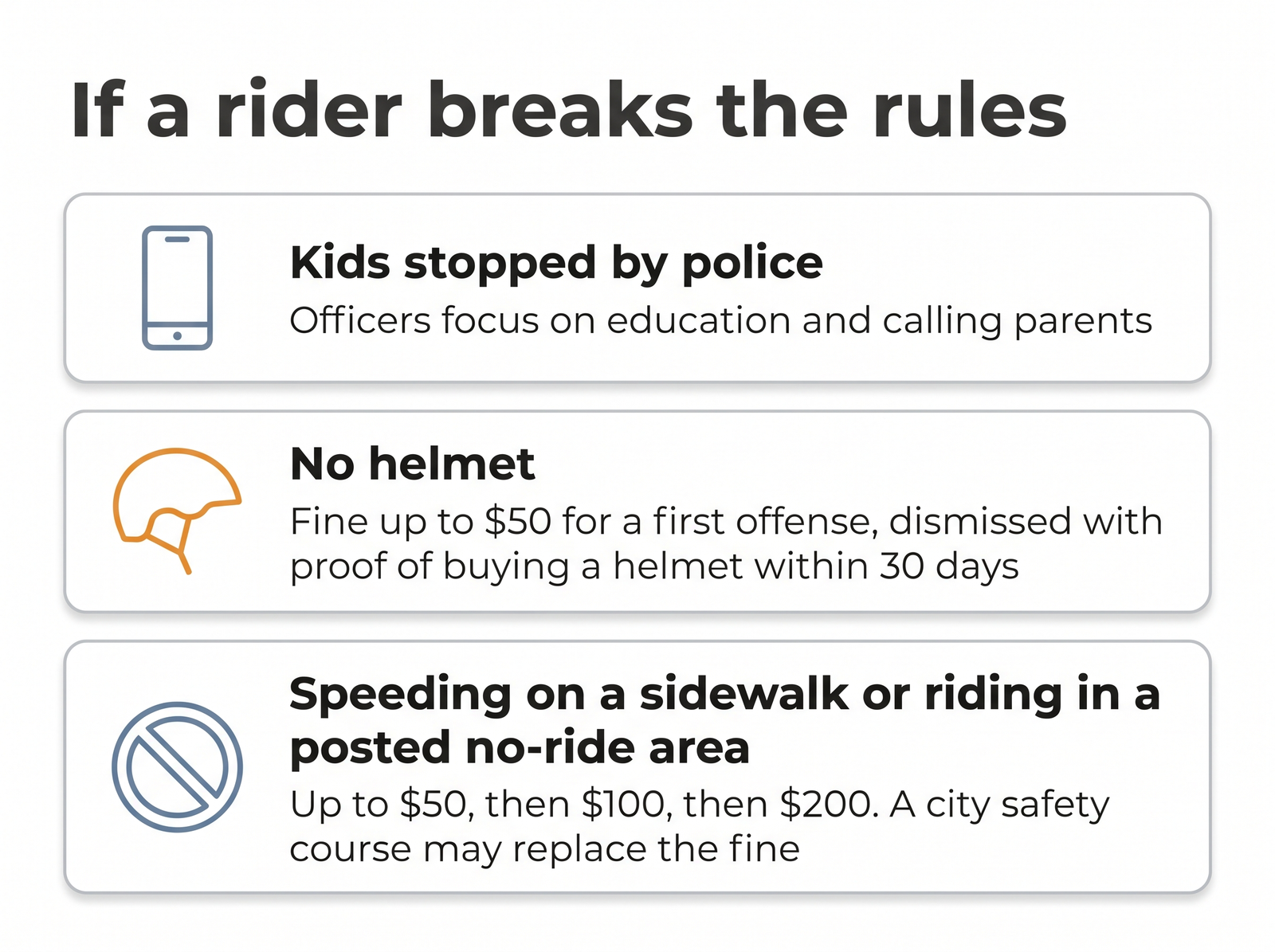 The penalties in the new ordinance.
Riding too fast on a sidewalk or in a posted no-ride area carries a fine of up to $50 for a first offense, $100 for a second, and $200 after that. A rider may be allowed to take a city safety course instead.
Dorothy asked to see how often stops end in a warning versus a citation, broken out by race, as the department reports for traffic stops. Kubasek said that data is held by the regional dispatch center, not the department's records system, and can be pulled.
Asked whether a young rider who breaks the rules could be required to retake the course, Spriggs said that would happen through juvenile diversion, which she will run, and could include lectures, essays, and videos with parents involved. She said it will be ready when the rules take effect.
Stay connected to what's happening in Worthington, Ohio.
The state bill
Spriggs also briefed council on Senate Bill 477, introduced Oct. 7 by State Sen. Bill DeMora, D-Columbus, which would set a statewide minimum age of 14 for Class 1 and Class 2 e-bikes and e-scooters, require helmets for every rider, and create a state registration and safety course. Stewart said the Mid-Ohio Regional Planning Commission told her the bill has not moved and could sit through the lame-duck session. Spriggs said Worthington's rules are less strict than the bill in some places, such as the age-12 floor, and stricter in others. "The state is the floor. We can be more restrictive, but not necessarily less," she said. The ordinance accepts either a city course or one required by the state Bureau of Motor Vehicles.
The school board discussed e-bikes at its last meeting, and district leaders said they hoped the city's rules would line up with those in Columbus and Perry Township, where some Worthington Schools students live. A council member asked how that would work; Stewart said the township, which is not a charter municipality, may simply fall back on state law. Council Member Amy Lloyd, who described the district's draft policy requiring students to get off and walk once on school grounds, said there are many unknowns, but "I personally feel like we just need to move forward with what we have." Another member noted that Westerville, Upper Arlington, and Hilliard have adopted their own rules even though some of their students also live in Columbus.
Public comment
One person spoke: a representative of the Ohio Bike Federation, a statewide cycling advocacy group. She thanked council for the changes made since October but questioned how drivers would know about a five-foot rule when the rest of the state uses three feet, and how riders from neighboring cities would know Worthington's rules. She worried about setting an age limit the state doesn't have, since young children are already riding scooters sold for ages 8 and up, and suggested letting them ride on sidewalks only. She said cycling groups oppose Senate Bill 477 and support a separate bill, House Bill 948, that would require bike shops to give buyers safety information. She asked council to enforce existing laws and wait for the state.
The vote
Pratt and Dorothy both voted yes while saying they had reservations. "I'm not completely comfortable with everything in here, as you know, but I think it's important that we get safety legislation as soon as possible," Pratt said, adding that council can revisit the rules once it sees how they work. Dorothy said she is also concerned about vulnerable users in the roadway and would like council to look at protected bike lanes. The ordinance passed 6-0; Council Member Pete Bucher was absent.
This is one of 2 Worthington Pulse stories from the November 2 city council meeting recap.