
This story is part of Worthington Pulse's coverage of the October 19 City Council meeting. Start with the October 19 meeting recap.
Worthington will add curbside food-waste collection to the trash, recycling and yard-waste service the city already pays for, after City Council voted 4-3 Monday night to award a five-year contract to The Compost Exchange over the recommendation of city staff (Ordinance 30-2026). The service is scheduled to begin January 1, 2027, and will be open to every single-family household in the city at no separate charge. What council did not decide is where the money comes from. That question moves to the November 2 capital-plan workshop, and City Manager Robyn Stewart said staff will need council's direction by the end of November so the cost can be built into the budget council votes on December 7.
What was approved
The Compost Exchange, a central Ohio hauler that already picks up food scraps from about 400 subscribing Worthington households on Tuesdays, submitted the lowest responsible bid at $3.28 per household per month. Director of Service and Engineering John Moorehead said that works out to roughly $207,000 a year in the city's general fund, offset by about $12,000 the city now pays a separate contractor to haul away the food-waste drop-off containers at the Recycling Convenience Center on Highland Avenue, for a net cost of about $195,000 a year, or roughly $975,000 over the five-year term.
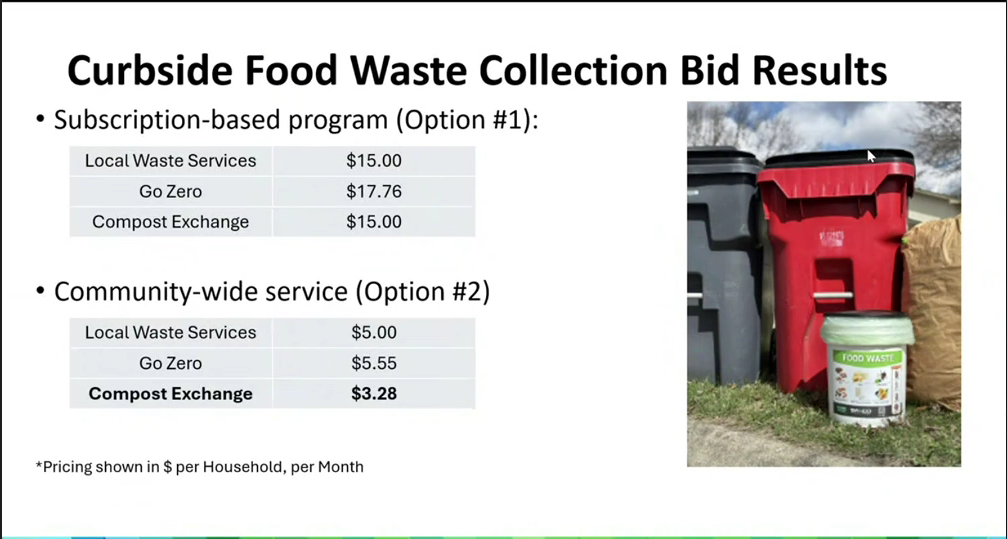 Director of Service and Engineering John Moorehead presented the bid results for both food waste collection options. From the video at 22:35.
The Solid Waste Authority of Central Ohio, known as SWACO, would reimburse the city up to $100,000, which the city can apply in one year or spread across several, pay for public education for the first three years, and supply the small lidded buckets households set at the curb. Spread evenly, the SWACO money brings the city's net cost to about $175,000 a year. The grant requires the city to run the program for at least five years.
Residents who want the service would sign up through the Service and Engineering Department, which would pass the list to the hauler and deliver the bucket. Pickup would stay on Tuesdays in the first year so existing subscribers keep their routine, and might later move to Friday to match the rest of collection, though Moorehead noted the small bucket can be hidden behind other carts on a crowded curb. The drop-off at the Recycling Convenience Center continues, with The Compost Exchange taking over that route from the current contractor. The contract covers households including duplexes and possibly triplexes, not apartment buildings.
A second bid option, a city-arranged subscription that residents would pay for themselves, came in at $15 a month and was not awarded. Moorehead said private haulers already offer the service for less, and a city award would have restricted other companies from operating in Worthington.
Why staff said no
Stewart opened by telling council the recommendation to defeat the ordinance was "not a commentary on whether the program would be a good program to have in Worthington" but a response to the city's finances. The five-year forecast in the proposed budget "has a notable deficit in every year," she said, and the forecast assumes expenditures grow only about 2 percent in 2029 and 2030, a pace the city has historically achieved only by cutting services. Because the SWACO grant locks in the program for five years, any cuts needed during that window would have to come from other services.
The staff memo laid out five ways to cover the cost, all of them one-time money: draw down the general fund balance, keep the Social Services Coordinator part-time instead of moving the position to full time (about $95,000), use the $500,000 set aside for still-unidentified housing initiatives, delay the Selby Shelter House renovation beyond the five-year capital plan, or scale the municipal building's first-floor project back to security and elevator work only. Stewart cautioned that deferring a capital project is not a saving if the work still has to happen in year six or eight.
Stay connected to what's happening in Worthington, Ohio.
How the four yes votes got there
Council Member Glen Pratt, who had asked at the previous meeting to bring the item back, said he was "loathe to go against the staff's recommendations" but considered the program a priority. He argued that even with composting, Worthington's combined collection rate would be lower than many communities pay for trash and recycling alone, that waiting would forfeit the SWACO money, and that about 15 percent of residents already compost. Of the five funding options, he rejected three: he would not take money from the housing fund, cut the social services position or draw further on reserves. He said he could support delaying the Selby Shelter House design or paring back the municipal building project, while acknowledging one-time money is "not the ideal solution." If the city's income-tax trajectory has not improved in five years, he said, council would need "the courage to cut back on services, and I suspect food composting may be one of the first things to go."
Council Member Amy Lloyd agreed with Pratt's read of the options and asked, given how low the bid came in, "if our numbers had been higher, would we be considering cutting recycling or trash?" She also suggested the recurring cost of the city's Flock license-plate cameras, which she recalled at around $50,000 a year, as a possible offset if the state moves against the cameras.
Council Member Pete Bucher said the real question is capital-plan priorities, and that the program's cost is "relatively minimal" next to many projects in that plan. He compared the step to the city's adoption of recycling 25 years ago and said his workplace uses The Compost Exchange: "It's clean, it's quiet, you barely even notice that they come and go."
Council President Rachael Dorothy, a former Compost Exchange subscriber who now uses the drop-off, said the city provides premium services and "this shouldn't be premium. I think it should be standard." She favored postponing the municipal building project to pay for it.
The case against, and a tiered-bid idea that went nowhere Monday
The three no votes came from Council Members Joycelyn Dong, Maria Ramirez and Rebecca Hermann, none of whom opposed composting itself.
Dong pressed staff on whether a commercial program would divert more food waste per dollar than a residential one. "In the context of a $3.7 million deficit, I want to make sure that $207,000 a year is being used wisely," she said. SWACO's food waste program administrator, Sara Gallaugher, a Worthington resident, told council SWACO already reimburses businesses for six months of new food-waste service and supplies containers, signage and training, and that about 60 percent of what reaches the Franklin County landfill comes from businesses. A Compost Exchange principal, Nick Schubert, offered a rule of thumb: one commercial account produces roughly 10 households' worth of food waste a week, but the number of food-producing businesses in Worthington is small next to its thousands of households. Dong said she felt council was "rushing into this decision, especially with pressures with this grant program."
Ramirez, a longtime subscriber who said she loves the service, said the low bid "is not a magic thing" but a product of the city paying one bill instead of the hauler billing thousands of customers, and that she worried about keeping up current services. "My heart might want it, but we have to make a decision based on the true numbers."
Hermann said she was "inclined to lean no because of the finances" but spent much of the discussion on an alternative Schubert raised: the bid required a hauler to serve all roughly 5,200 households if they signed up, with no middle tier, and he said the company "would undoubtedly lose money" if every home enrolled on day one. A tiered contract that started with, say, 1,000 households could cost the city less per home and let both sides learn how many residents actually participate. Gallaugher said SWACO has been discussing tiered models and its support would not go away under one, as long as the service stays open to everyone. Staff were cooler. Stewart said a tiered structure changes the bid terms enough that the city should reject all bids and start over to keep a level playing field for other haulers; Moorehead said that would push a start date past January and that no Franklin County program is bid that way. Hermann's conclusion: once residents have a service for five years, "the hardest thing is gonna be to pull that back. I think it'd be easier for us to delay a start than to pull back."
What residents said
Six people spoke, all in favor. A Worthington Partnership Green Team member traced the city's food-scrap efforts to 2019, when a 400-household drop-off pilot filled up, and called curbside pickup "the next step in landfill diversion" after recycling. A parent who helps run the composting line at Worthington Estates Elementary said about 90 student volunteers sort lunch waste every day and that staff from Hilliard schools are coming to observe it. The president of the Worthington Area Chamber of Commerce said the city is "running a deficit budget because we don't have enough businesses here paying income tax" and that the Chamber is encouraging its members to join SWACO's business program.
Gallaugher also supplied a number council had asked for: the Recycling Convenience Center drop-off alone diverted 58,657 pounds of food waste last year. The Compost Exchange said it will report pounds diverted to the city monthly.
The vote and what comes next
The roll call was Lloyd, Pratt, Bucher and Dorothy in favor; Hermann, Ramirez and Dong opposed. Dorothy closed the item by saying "everyone is supportive of having composting in the community. It's just how that is done."
Later in the meeting, Dong asked whether council would know by the end of its November budget sessions where the $207,000 is coming from. Stewart said the capital plan comes up November 2, that several members had pointed at the Selby Shelter House or the City Hall renovation, and that staff will ask for a decision by the end of November. Residents who want to weigh in can watch the November 2 meeting or contact council members through the city's council page.
This is one of 3 Worthington Pulse stories from the October 19 city council meeting recap.