
This story is part of Worthington Pulse's coverage of the October 26 Board of Education meeting. Start with the October 26 meeting recap.
Every Worthington elementary school now sets aside a block of each day for WIN Time, short for "What I Need." During that block no new grade-level lessons are taught; students instead get extra help, practice or enrichment matched to what they need right now. Executive Director of Elementary Education Rob Messenheimer and Linnea Gallo, coordinator of teaching and learning for preschool through fifth grade, briefed the Board of Education on Oct. 26. The block is in every schedule now, they said, and this year's work is making the time count.
"I want to be super transparent that we feel like we have a ways to go before we're really efficient in how we're doing WIN time in our buildings," Messenheimer said.
Why the district built it
Messenheimer described WIN as "a dedicated period within our elementary school day where no new grade level instruction occurs". He gave three reasons for it, laid out in the district's presentation:
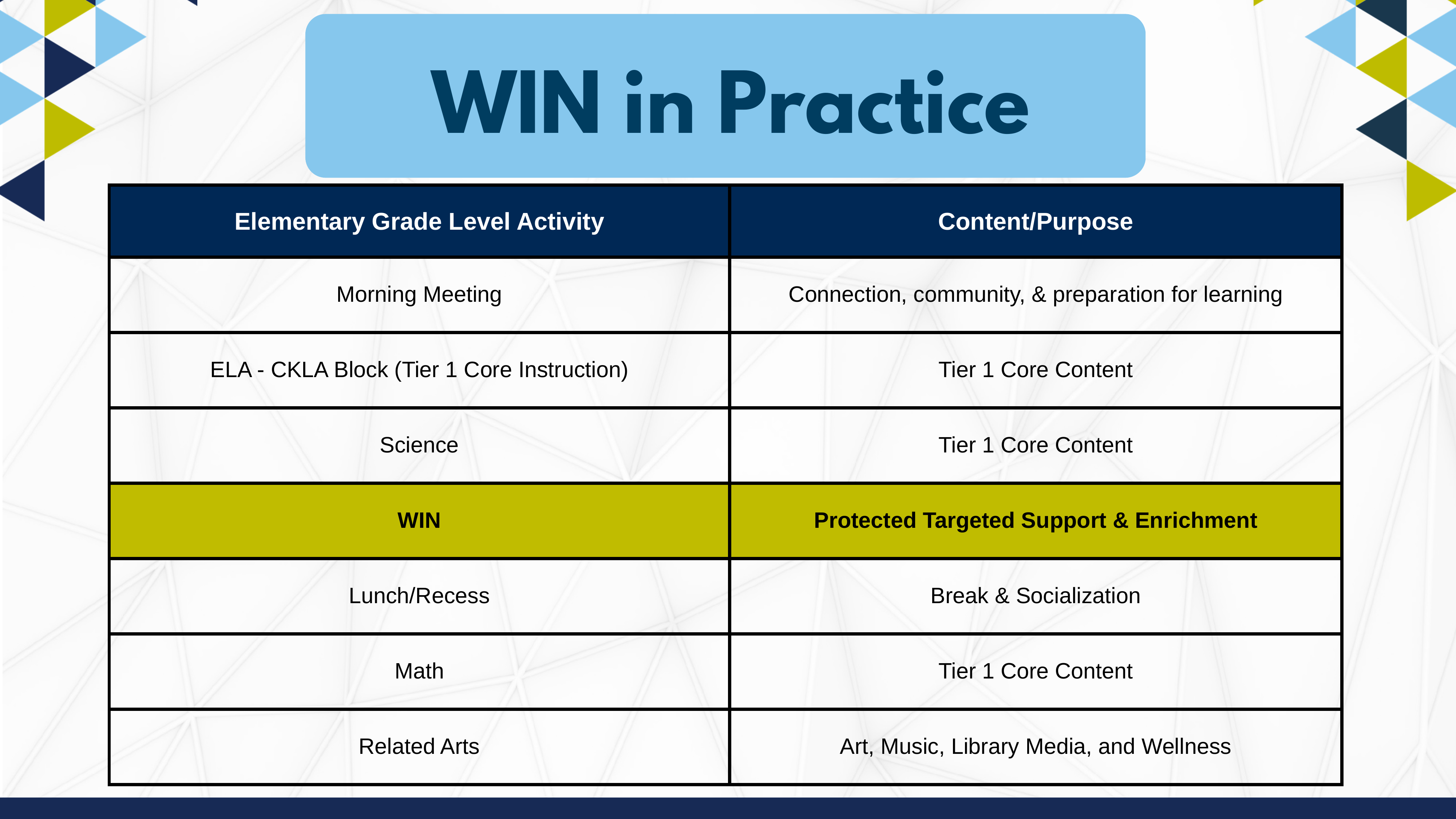 A sample elementary schedule with the WIN block between science and lunch. Source: WIN Time presentation to the Board of Education, Oct. 26, 2026, slide 4.
A special education audit. The audit reinforced that intervention "should always come in addition to core instruction. It should never be a replacement for that time". The district's presentation says the goal is that students with IEPs or intervention needs stop missing core lessons while they receive support services.
The reading curriculum. The district's elementary reading program, CKLA (Core Knowledge Language Arts), is a structured literacy curriculum, which Messenheimer described as systematic and explicit. He said students need every part of it to become strong readers and writers, so the district wants them in the room for the whole block.
A new state math law. Ohio's Senate Bill 19, a math intervention law passed this summer, wasn't on the radar when planning began, Messenheimer said, but WIN will help the district meet it. He said the law requires districts this year to provide math intervention to students who score low on the state test or fall short of benchmark on the district's screening tests. Next school year, it requires advanced learning opportunities for students who score at the top levels.
A sample schedule in the presentation places WIN between science and lunch, after the morning reading block. Messenheimer said real schedules vary by school and even by grade, depending on how lunch, recess, art and music line up and how many teachers share a grade, but the block is now in place at every elementary school for every grade.
What happens during the block
Messenheimer said WIN is meant to deliver three things:
- Targeted intervention: small-group work on a specific skill, such as phonics, fluency or a math concept.
- Enrichment: for the many students who are meeting or exceeding grade-level expectations.
- Integrated support: the district's specialists, including intervention specialists serving students on IEPs, reading specialists, Title I math teachers, English language teachers, mental health specialists and school counselors, all need time with students, and WIN gives them a predictable window.
Teachers in a grade level are expected to group students across classrooms. If three second-grade classes each have a handful of students with the same need, one teacher might take that group while another teacher takes a different one and some students head to a specialist.
Messenheimer said one benefit is less stigma. In the past, a student might have to leave class and walk down the hall to an interventionist. During WIN, "every student is going somewhere to receive something". Some students who receive several services still can't fit them all into WIN, he said; for them, specialists and classroom teachers look for the least disruptive time in the day, such as independent work time.
Stay connected to what's happening in Worthington, Ohio.
How teachers decide who needs what
Gallo said the first step, last year, was giving every elementary school a master schedule. "We haven't asked our elementaries to have master schedules before," she said. The district also worked with teachers on why protecting core grade-level instruction matters for every student.
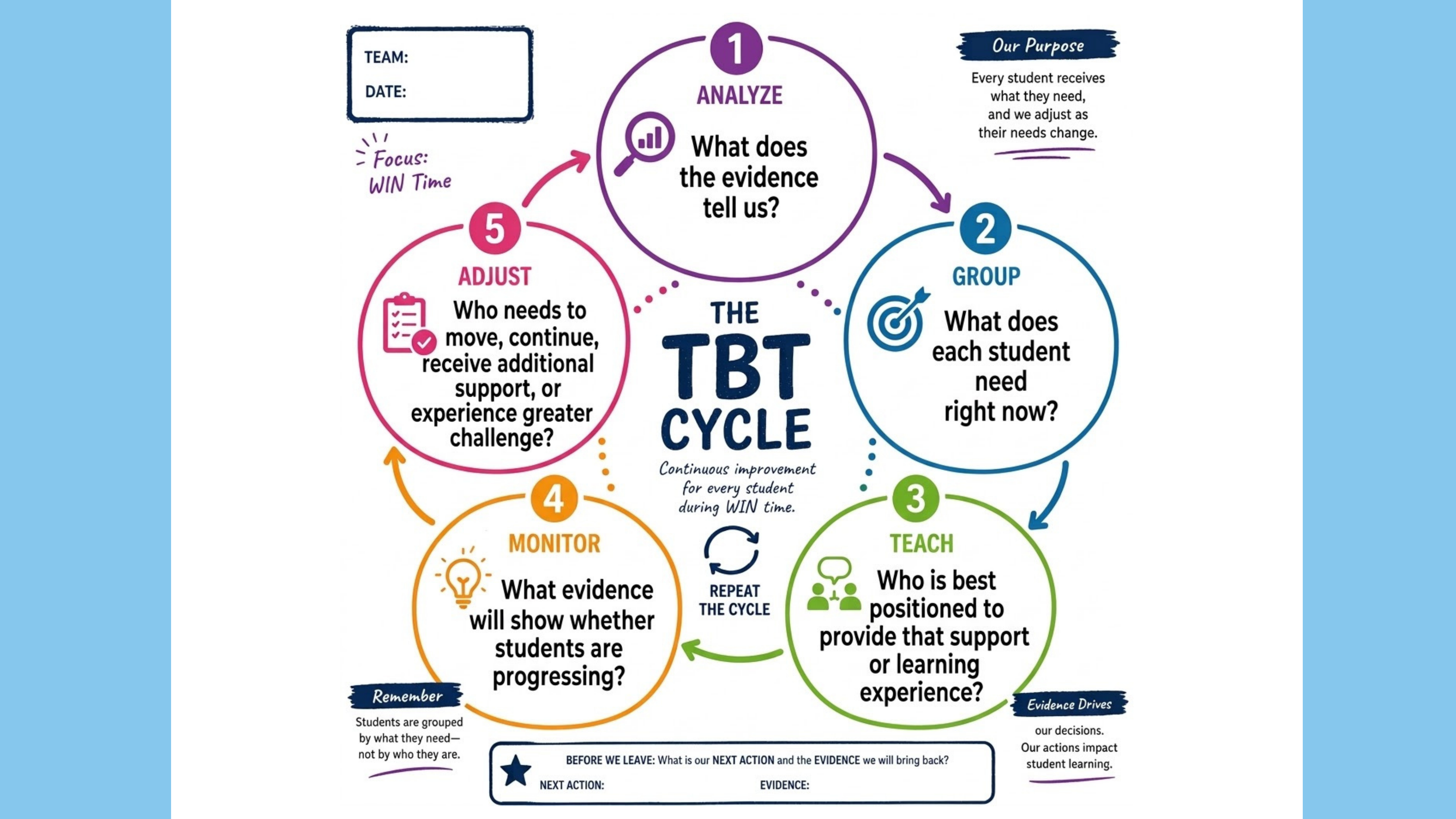 The five-step cycle teacher teams use to plan WIN groups.
This year's focus is the planning, which Gallo acknowledged is a heavy lift, especially for kindergarten through third-grade teachers who already plan every subject every day. Teachers have to group students using data, pin down what each group needs, find the right materials, measure whether it worked and adjust.
To support that, the district built on teacher-based teams, groups of teachers who already meet twice a month in every school to look at student data. Instructional coaches now join those meetings once a month, and principals attend as well, which Gallo called "really a big commitment" from principals. The district has laid out a month-by-month plan for those meetings through December.
In those meetings, teachers sort students by what the data shows. Gallo described a color-coded sample class:
- Red: students who need intervention.
- Orange: students who get intervention as a precaution, so a small gap doesn't grow.
- Green: students who need more practice or an extension of what they're doing.
- Blue: students who need a real extension beyond grade level.
The team picks a focus for each group, uses curriculum materials the district already has rather than asking teachers to create new ones, decides how to track progress, and then starts the cycle over. A group might work on reading for three or six weeks and then switch to math.
What board members asked
A board member with a child in elementary school said WIN "has been amazing" in her family's experience and that her children understand why they do it. Vice President Stephanie Harless noted that WIN is a heavy lift for teachers and asked what their feedback has been. Gallo said the district saw that coming and put instructional coaches alongside teachers from the start. Teachers "understand the lift, they feel supported," she said, and "it's been positive so far." Asked whether there is early data on whether WIN is working, Gallo said it is "really too early to tell".
Board member Sheena Costa Flowers asked how quickly a student's plan can change. "We're not going to keep a student in an intervention or an extension when there's something else they need," Gallo said. Costa Flowers also asked about students with IEPs or 504 plans. Messenheimer said those students come first: the priority is for them to see their interventionist during WIN so their other lessons stay intact.
Board member Nikki Hudson asked who leads enrichment, since the list of intervention specialists is much longer. Messenheimer said the district's gifted intervention specialists teach scheduled gifted math classes at the elementary level, so their schedules don't let them cover WIN for every grade. He said Suzanne Palmer, the district's coordinator of gifted education, is working with those specialists this year to build enrichment materials any classroom teacher can use during WIN, starting with math. Messenheimer added that classroom teachers who work with gifted students must complete training hours each year. Hudson said the work should be in place before next year's advanced-learning requirement takes effect.
Board member Kelli Davis said she was glad WIN covers enrichment as well as intervention, since parents often say they want their children challenged.
The district's plan for teacher-team meetings runs through December, when teams are to review progress and set next steps for the next trimester. There's no data yet on whether WIN is improving results; Davis said she looks forward to hearing them when available. The enrichment materials for WIN are being developed this school year, ahead of the state's advanced-learning requirement next school year.
This is one of 2 Worthington Pulse stories from the October 26 Board of Education meeting recap.