
This story is part of Worthington Pulse's coverage of the November 9 Board of Education meeting. Start with the November 9 meeting recap.
Worthington Schools collected about $2.5 million less in real estate taxes than it projected, after receiving its delayed second-half property tax settlement at the end of October, the second Franklin County settlement this year to arrive late. Treasurer TJ Cusick told the Board of Education on Nov. 9 that three things drove the shortfall: more commercial property owners behind on their taxes, more money refunded to owners who won valuation disputes, and apartment complexes continuing to move from the commercial to the residential tax rolls. Whether the gap carries into future years is a question for the district's next five-year forecast in February.
Real estate taxes are the district's largest source of money. "We're a locally funded school district," Cusick said, and real estate taxes make up about 74% of the general fund revenue the district projects for this fiscal year, according to the October monthly financial report. That report puts collections at about $66.5 million against a $69 million estimate, a gap of nearly 4%.
Three reasons for the gap
More owners behind on their taxes. Worthington historically collects 96% to 97% of what it bills. Cusick said the commercial delinquency rate rose from 4.8% last year to 5.8% this year, and the residential rate rose about half a percentage point. Together, those accounted for almost $1 million of the shortfall.
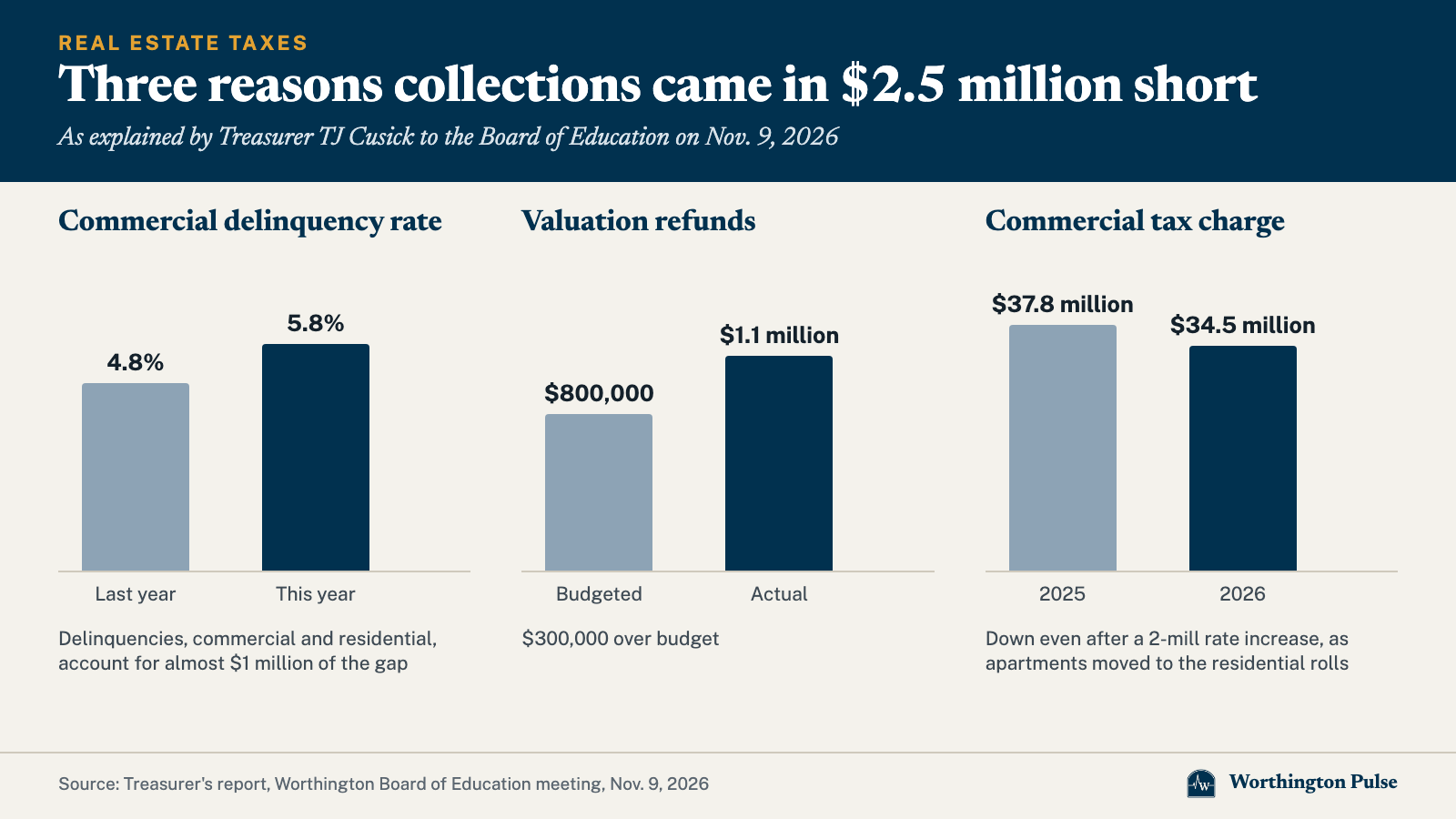 The three causes Treasurer TJ Cusick gave for the real estate tax shortfall. Source: Treasurer's report, Worthington Board of Education meeting, Nov. 9, 2026.
Larger refunds after valuation disputes. When a property owner challenges the county's valuation, Cusick explained, "they have to pay their taxes. It usually takes a few years for that case to be heard. And then if they win, we refund them those back taxes." He had budgeted about $800,000 for refunds; they came to $1.1 million, adding another $300,000 to the gap. Cusick said the overage was in commercial refunds.
Apartments moving to the residential rolls. Cusick returned to a trend he has raised before: multifamily housing developments being reclassified from commercial to residential property. The district's total commercial tax charge, what it bills commercial owners, fell from about $37.8 million in 2025 to $34.5 million in 2026. "So it went down three million dollars when our tax rate went up two mills from our last increment," he said, referring to the latest step of the district's incremental levy.
Ohio taxes apartment buildings with four or more rental units as commercial property. When an owner files a condominium declaration for a complex, its units are taxed at the lower residential rate, even if they are still rented, according to a Vorys law firm summary of state tax law. In June, Cusick pointed to one example, a property named "The Heights," which he said had been reclassified from a single commercial unit into hundreds of condominium units to lower its tax bill. Converted buildings get two breaks: the lower residential rate and a property tax credit worth up to 10% of the taxes from older levies. A state law signed in December 2025, House Bill 186, phases out the credit starting with tax bills paid in 2027, but leaves the residential rate in place.
When the district closed fiscal year 2026 in June, Cusick reported that real estate taxes had come in about half a million dollars under projection and attributed it to the same reclassification. He said then that the shortfall would likely repeat in the second half of the calendar year.
Utility taxes, spending and the cash balance
Utility taxes, paid by public utilities on their property in the district, came in almost $700,000 above projection. Cusick said the county raised those valuations late, with an adjustment made around April, so the district received more in the second half. He said he hopes the higher amount continues.
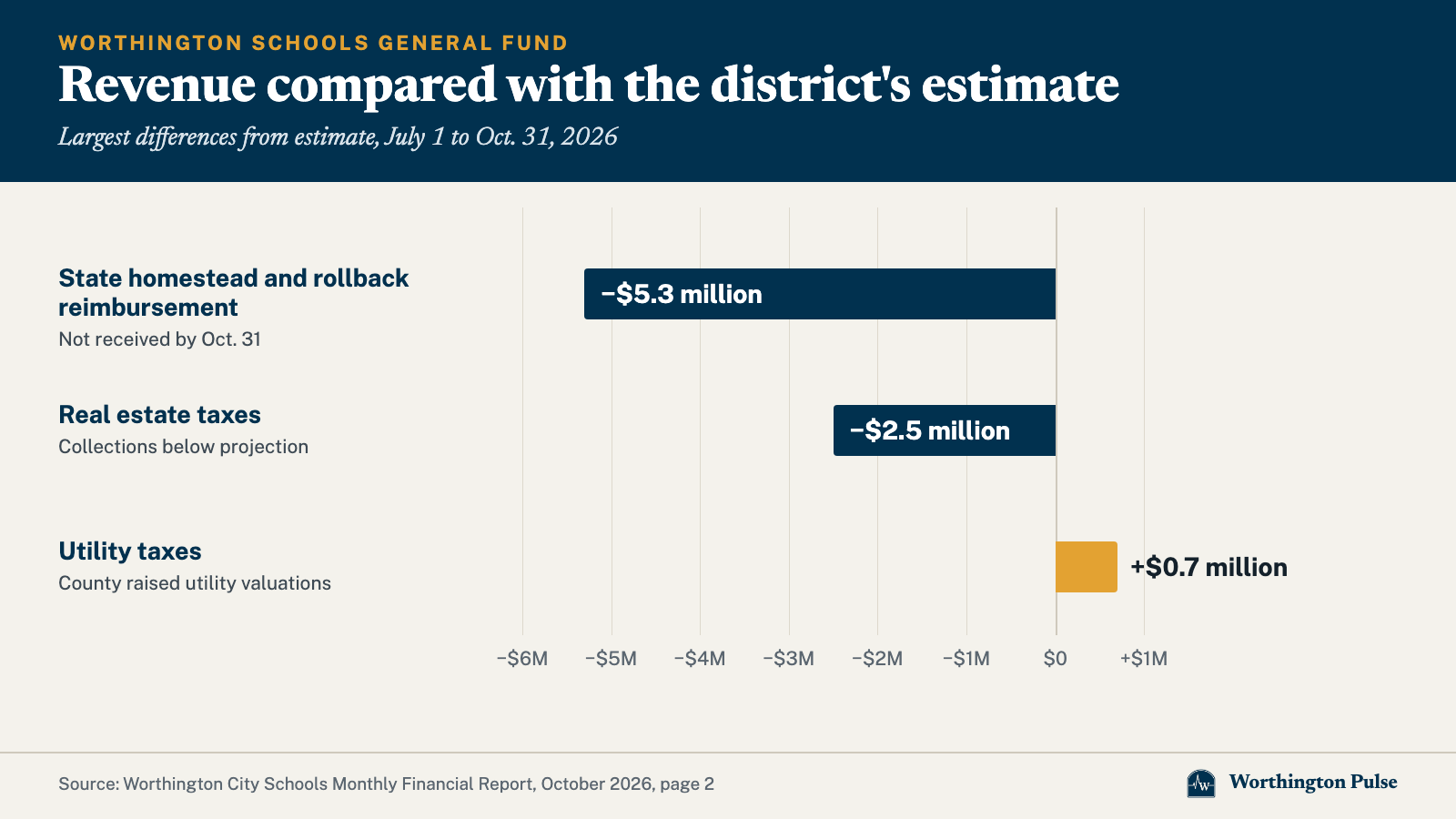 The largest differences between the district's revenue estimate and actual collections through October. Source: Worthington City Schools Monthly Financial Report, October 2026, page 2.
Cusick said every other area of the budget is on target. Spending through October was within about $214,000 of the estimate, according to the report's year-to-date comparison.
The report's summary also shows the district's cash balance about $6.9 million below estimate, which it attributes to "a delay in homestead, and rollback from the State combined with actual property tax collections slightly below estimates." Most of that is the state payment: about $5.3 million in reimbursement for homestead and rollback tax credits, which the state pays the district to cover property tax reductions it gives homeowners, had not arrived by Oct. 31.
Stay connected to what's happening in Worthington, Ohio.
The February forecast
Heading into February, Cusick said, the question is whether delinquencies keep rising or the district collects that money later. He has asked for a report listing every delinquent account but has not received it yet. He recalled a year when "we just had one big payer that was a couple days late that drove the whole issue." He will look at the delinquencies and decide how to treat them in the February update of the five-year forecast.
The district's August forecast already showed spending outpacing revenue starting next fiscal year. That forecast was built before the second-half settlement arrived, using February's property tax figures.
Levy results and cash balances statewide
Later in the meeting, Board President Amber Epling-Skinner, the board's legislative liaison, shared statewide results from the Nov. 3 election, compiled by Howard Fleeter of the Ohio Education Policy Institute. Just over half of Ohio's school levies passed, 72 of 134, down from about two-thirds in November 2025. Requests for new operating money passed at the lowest rate, and renewals of existing levies passed below their historic rate. Fleeter attributed part of the drop to an unusually high number of new operating levies, which historically pass at lower rates.
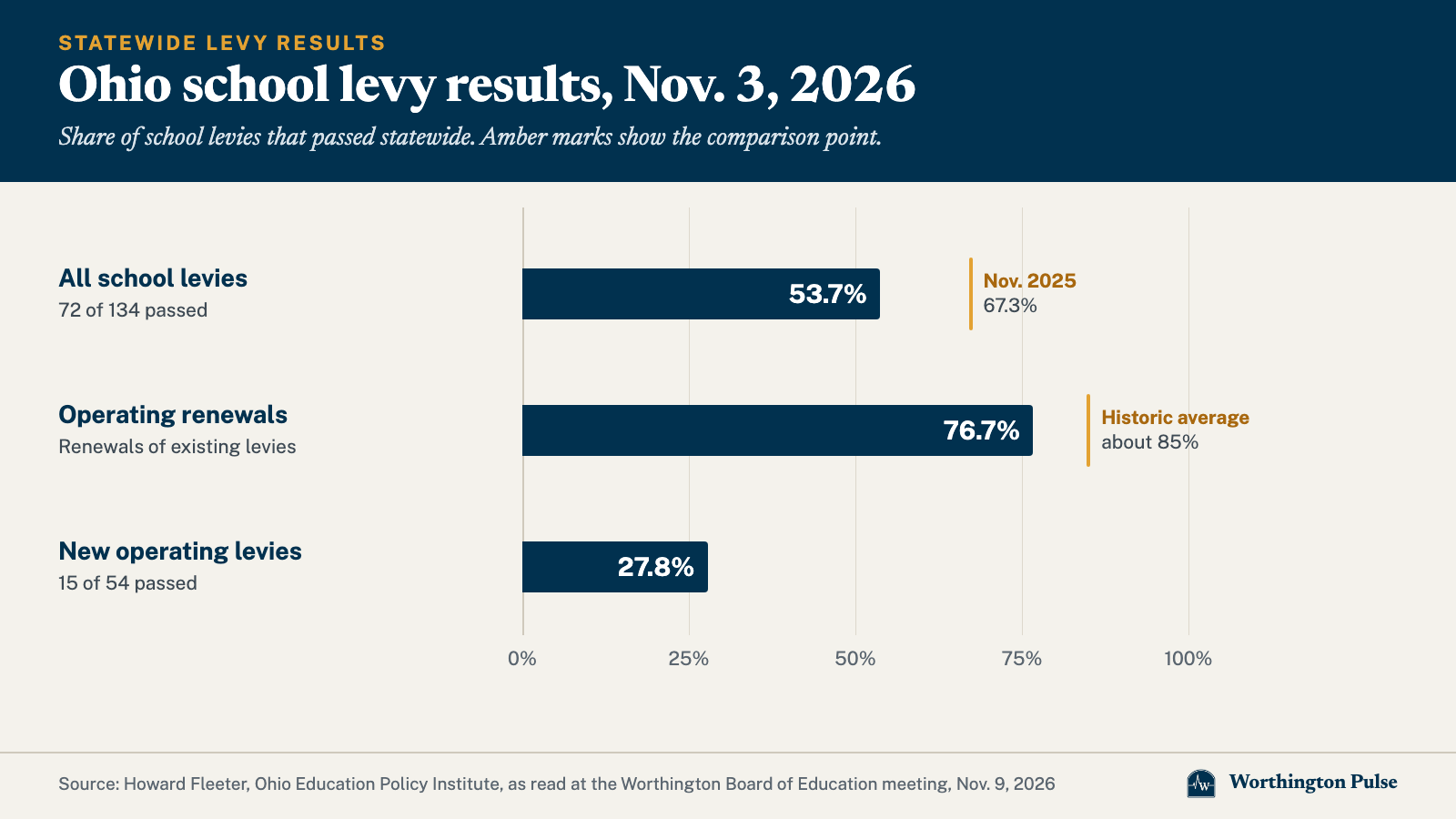 Statewide school levy pass rates from the Nov. 3 election. Source: Howard Fleeter, Ohio Education Policy Institute, as read at the Nov. 9, 2026 Board of Education meeting.
"We're still a couple years out," Epling-Skinner said, referring to the district's own next levy, which the district's budget planning has aimed to hold off until 2028.
A board member asked whether the number of operating levies statewide was tied to a recent change in the state's 20-mill floor, the minimum property tax rate Ohio requires school districts to collect for operations. Cusick said he would want to look into it before answering. More generally, he said, more districts are facing much smaller cash balances than they had years ago, and "we've seen a record number of schools facing negative cash balances in the third and fourth year of their forecast."
This story comes from the November 9 Board of Education meeting recap.