
This story is part of Worthington Pulse's coverage of the September 14 Board of Education meeting. Start with the September 14 meeting recap.
Families across Worthington will hear from their schools sooner this year when a child's absences begin to add up, the result of a new Ohio attendance law that Assistant Superintendent for Academics Jennifer Korn walked the Board of Education through on September 14. The change moves the district away from the reactive, court-driven truancy system schools operated under for nearly a decade and toward earlier, less punitive outreach.
What the law changed
For years, districts followed House Bill 410, which Korn described as a reactive system: schools waited until attendance problems reached a legal threshold, then triggered prescriptive timelines that could end in juvenile court. House Bill 96 keeps truancy in the law but builds a prevention framework around it. "House Bill 96 didn't get rid of truancy," Korn said, "but it built all of this prevention strategy around it".
The most visible change for parents is earlier notification. Ohio now requires districts to send an official notice once a student misses 5% of the school year for any reason, excused or unexcused. Superintendent Trent Bowers put that in concrete terms on his blog, writing that 5% equals roughly 45 to 50 hours of missed school depending on grade level. Chronic absenteeism itself is defined as missing at least 10% of the school year.
Korn was emphatic that the earlier contact is not a crackdown. "It does not mean we are becoming more punitive," she said. "It means we're becoming more proactive". The first notice is automated and not personalized; principals see it before it goes out and can call ahead when they already know a family faced illness or a loss. If a pattern continues, the district moves to personalized contact from a "safe adult" a student already trusts, and staff have practiced scripts for those calls.
Where Worthington stands
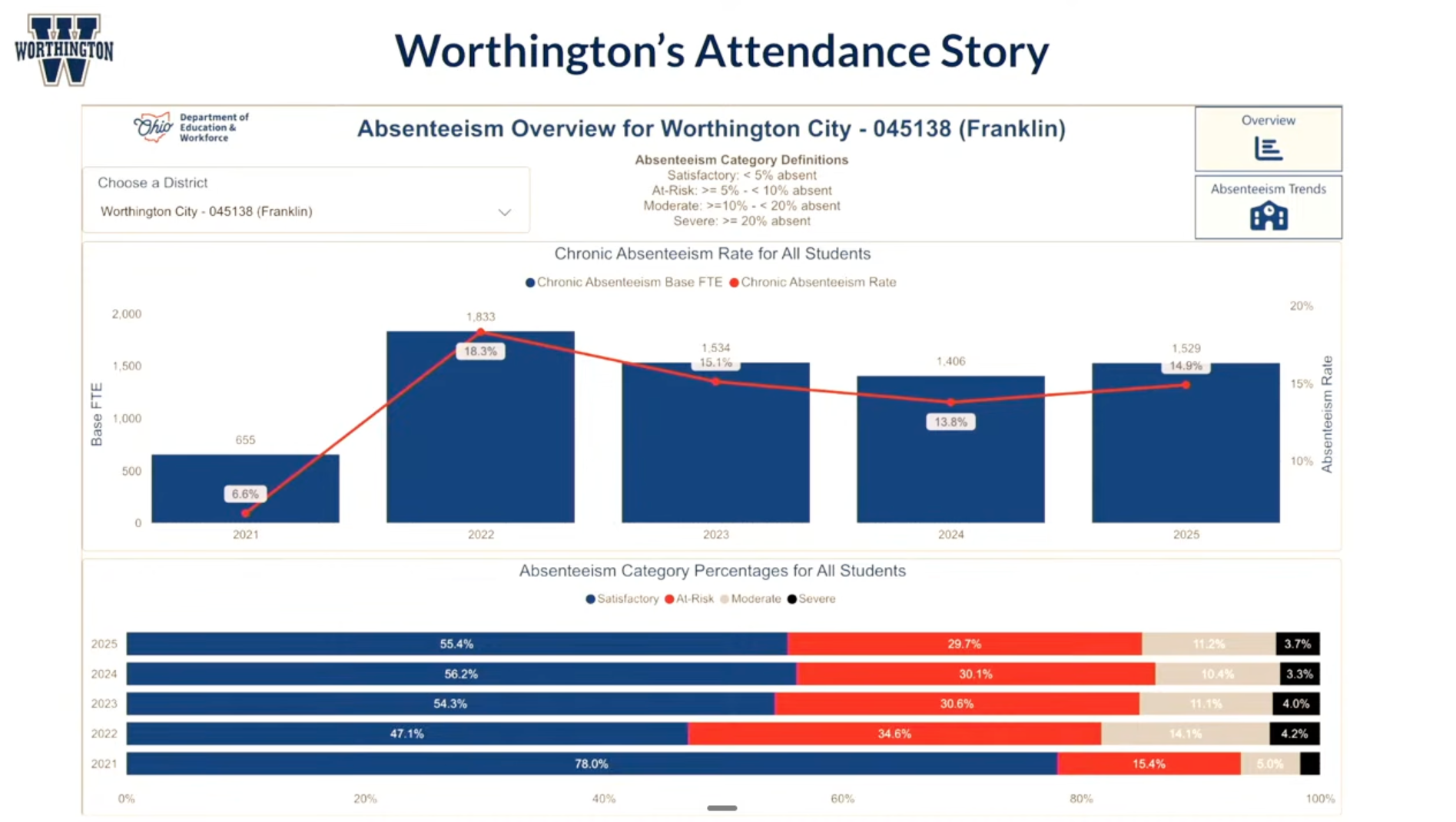 Worthington schools absenteeism over time (2021 includes pandemic)
Korn shared five-year trend data showing the district's chronic-absence rate reached 15.2% at the end of the 2025-26 year, meaning that share of students missed at least 10% of possible school days. She asked the board to read the 2020-21 pandemic figure with caution. Worthington remains well below the statewide rate of about 25%.
The presentation broke the numbers down by student group. Hispanic students, economically disadvantaged students, and students with disabilities all showed consistently higher rates, and English learners were the one subgroup whose gap is widening. "We don't close gaps simply by labeling them," Korn told the board, adding that behind every percentage "is a student, a family, and their lived experiences."
For the coming year, the district set a specific goal: reduce each school's chronic-absence rate by about two points.
The board's questions
Board members pressed on how the new approach works day to day. They asked how absence teams are built around individual students rather than assigned per building, whether the district can soften the legalistic tone of the required letters, and how outreach reaches families in their home languages. Korn said the notification letters can be customized as long as they meet the state's requirement to notify, and that translated materials and interpreters are part of the plan. One board member asked whether the state's new attendance dashboard was useful; Korn was candid that the district's own systems are more reliable for now (Worthington schools are able to more effectively pull and display data in house).
Underlying the mechanics, Korn returned to a single theme: relationships drive attendance more than policy does. "Students return to people," she said. "They don't return to programs". She noted Worthington is in its second year as an "All-Star District" in the Stay in the Game network, a statewide attendance effort managed by Battelle with the Columbus Crew as its pro-sports partner, and that September is Attendance Awareness Month.
This story comes from the September 14 Board of Education meeting recap.