This story is part of Worthington Pulse's coverage of the February 9 Board of Education meeting. Start with the February 9 meeting recap.
Worthington Schools has retired the Panorama survey it gave students for eight years and replaced it with a survey of its own, written around the district's Portrait of a Learner, the five skills the district says it wants every graduate to have. The first round, given in fall 2025, drew responses from 83% of students in grades 3 through 12. On Feb. 9 the three staff members who built it walked the Board of Education through why the district made the switch, what students are asked, and what parents will see at conferences.
The survey is not anonymous. Each student's answers are tied to their name so that a teacher, counselor or parent can sit down with that student and talk about them. That design choice, and the student focus groups that shaped the questions, took up most of the board's questions.
Why the district dropped Panorama
Assistant Superintendent Angie Adrean told the board the district began giving the Panorama survey in 2017 to understand school culture and students' social and emotional experience, and that it "has given us valuable insight". Two things changed since then. In the 2023-24 school year the district wrote its Portrait of a Learner with staff, students, families and community members, setting leveled expectations for elementary, middle and high school students. In 2024-25 it trained staff district-wide on executive functioning, the skills students use to manage their learning and regulate their emotions.
The new survey folds both into one instrument. "No longer the Panorama survey, now the Portrait of a Learner survey," Adrean said. The questions are written to the Portrait's durable skills and to executive-functioning strategies teachers already use in class. "Students aren't just answering questions, they're being asked to reflect on the skills that we've talked about in class that their teachers have practiced and modeled".
Board members later asked what the district gives up by leaving Panorama. Adrean said Panorama came with a toolkit of classroom lessons for areas that scored low, such as sense of belonging, and that the district intends to build its own equivalent. Board Member Nikki Hudson asked whether improvement areas identified under Panorama carried over; staff said belonging had always been a focus and offered to follow up.
How it was built
Nathan Kellenberger, the district's Coordinator of Behavior Support and Mental Health Services, described a year of work. Staff spent spring and summer 2025 researching how to write survey questions for children, including Likert scales and question design, and the slide deck closes with two pages of citations (deck, pages 13-14). In the fall, administrators, the Academic Achievement and Professional Learning team and the district's school psychologists took the draft and sent back changes.
Then staff took it to students. Focus groups at an elementary, a middle and a high school read the draft questions and told the adults where the wording did not make sense. "We walked into those meetings thinking that we were in a really good spot with our survey until the students gave us feedback," Adrean said. Kellenberger said the students were "amazing to talk to" and that the district made "a lot of good changes as a result of that".
The district also had an outside statistician review the method. Brian Geniusz, a district curriculum specialist, said staff went over the entire process, the questions and the analysis with Dale Rhoda, a Worthington resident who is founder and president of Biostat Global Consulting, a firm that designs and analyzes surveys for public-health projects. Rhoda offered a few suggestions, Geniusz said, and "felt that we did a very strong job". The deck credits him in its citations (page 13).
Stay connected to what's happening in Worthington, Ohio.
What students are asked
There are three surveys, one per grade band, and each asks five questions about each of the Portrait's durable skills (deck, page 6):
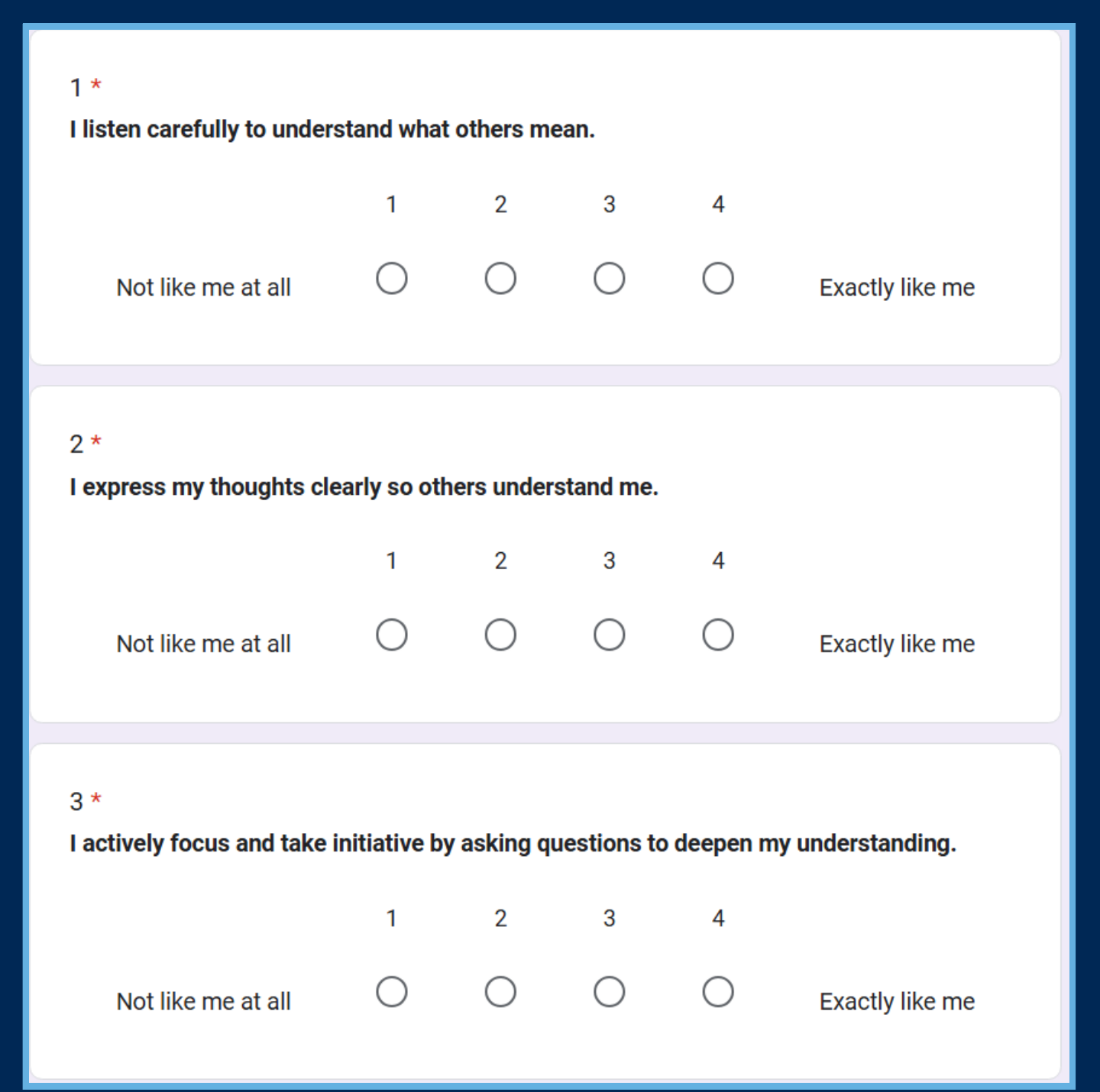 The first three questions of the high school survey as students see them in Google Forms. Source: Portrait of a Learner presentation to the Board of Education, Feb. 9, 2026, page 6.
| Grades | Questions | Fall 2025 completion |
|---|---|---|
| 3-5 | 15 | 92% |
| 6-8 | 20 | 88% |
| 9-12 | 25 | 74% |
| District | 83% |
Students answer on a four-point scale, from 1, "not like me at all," to 4, "exactly like me." A sample item from the high school survey reads "I listen carefully to understand what others mean". Geniusz said the team debated a five-point scale and settled on four, "a debated topic in all surveys, actually".
The survey is a Google Form that students open through their normal school login. Kellenberger said no version takes longer than about eight minutes, usually five to eight. It is given twice a year, in the fall and spring, so staff can look for change within a school year. Before each round, principals send families a letter, and parents can read every question and opt their child out. Each survey ships with a short lesson plan that introduces the vocabulary and lets students practice the response scale before they answer.
Translated versions were produced with the district's English Learner department, and bilingual assistants can work through the questions with students one on one, Kellenberger said in response to a question from Board Vice President Stephanie Harless about whether cultural differences might change how students read the items.
Confidential, not anonymous
"The survey itself is not anonymous, but it is confidential for us," Kellenberger said. "That's important to us because we want to know who the students are". He described a high school student who contacted Adrean asking to answer anonymously; after a conversation about why the district wanted names attached, the student agreed to take it.
Harless asked who can see an individual student's answers. Geniusz said the district follows federal student-privacy law, so anyone with "an educational interest in that child," such as a counselor or school psychologist as well as the classroom teacher, can see the data. Asked whether certain answers automatically trigger a follow-up, Geniusz said the district is "still in the infancy" on that and that slicing results by demographics is work still ahead.
What teachers, students and parents see
Geniusz showed the board a series of reports built from the fall data (deck, pages 7-11). For one student, each answer is color-coded by how positive it was and tagged with the skill it measures. Those roll up into a one-page skill summary for the student that also shows the school and district averages. "This is a self-reported survey. So it's not necessarily fact. It's how the student perceives their own skills," Geniusz said.
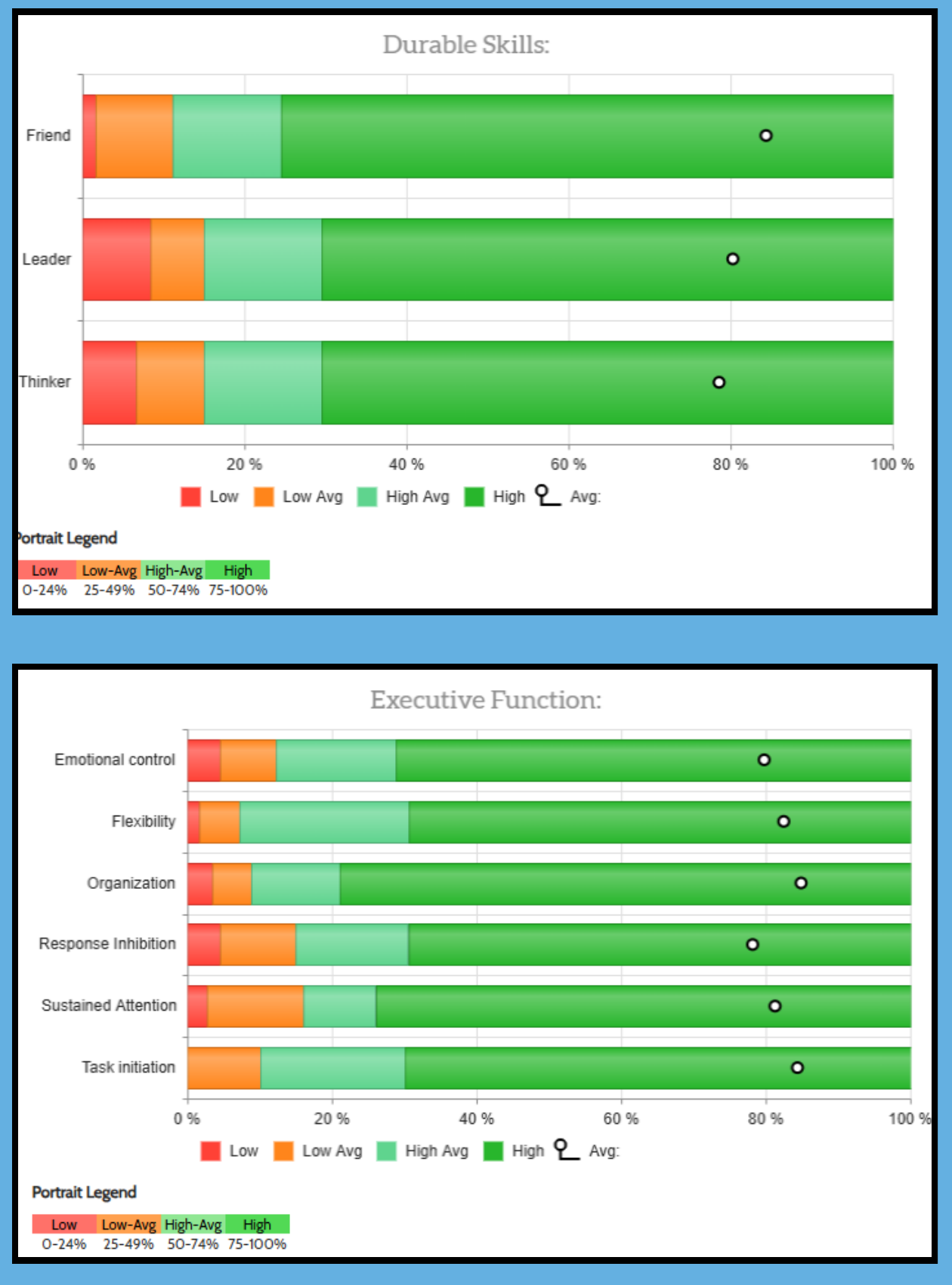 Sample school-summary charts for durable skills and executive-function skills.
For a teacher, the same data becomes a classroom grid, one row per student and one column per skill, that can be sorted to show which students rate themselves low on, say, resilience. School and district views show the distribution for each skill. Most students, Geniusz said, gave themselves "very positive responses", and the district-wide picture shows "a very positive self-confidence from our students".
The point of the individual view, he said, is to keep those averages from hiding anyone. "When you get a large group, you start muting out. And I think that's what this effort is all about, is to not mute out those kids that are on those edges".
Kellenberger listed four uses for the reports (deck, page 12): conversations between a teacher and a student whose self-rating does not match what the teacher sees; professional learning where a skill scores low school-wide; the district's multi-tiered system of supports for identifying students who need help; and parent-teacher conferences. One middle school principal told him families looking at their child's results at conferences said "wow, that is my kid". A board member who had seen her own child's results said the same: "it did look like her".
The board's questions
Hudson said the switch let the district measure "tangible skills that we are teaching our students" while also strengthening relationships, and that a student who comes up "red, red, red" across skills is a sign "that there's something else that's going on" that an adult can step in on.
Board Member Kelli Davis said the difference from Panorama is that this survey attaches to what students do "throughout the school day, every day" rather than standing apart as a one-time exercise.
Board Member Sheena Costa Flowers, who said she took part in writing the Portrait as a parent and alumna, asked whether students could eventually get a self-facing guide to their results, something like the strengths reports used in workplaces. Geniusz said that is "future thinking" that would take help from the technology team, since Google Forms does not produce student-facing analysis, and invited a board member to join that work; a board member immediately offered to help. Adrean cautioned that any such report is "a guide for a point in time" and that the district does not want to pigeonhole a student whose answers may change from spring to fall.
Board President Amber Epling-Skinner asked whether the district would also survey parents or teachers about students, so a student's self-view could be compared with an adult's. Adrean said Panorama had student, staff and family versions and the district will "get there". Epling-Skinner also asked about the 74% completion rate in grades 9-12 and whether the district would chase the students who had not responded. Adrean said the district extended the high school window because older students arrive late, leave early and take classes elsewhere, and will keep working on it. "At every level, those completion rates are higher than they ever were with Panorama," she said, crediting the lesson plans that explain to students why they are being asked.
Harless said: "Implementing this at all and transitioning from the Panorama survey, this is great". The second administration was scheduled for spring 2026, and Geniusz said the fall chart will gain a second bar when those results come in.
What came next
The district gave the survey a second time March 16 through 27, 2026, according to a Feb. 20 district email to families, which described the fall round as a baseline and the spring round as "about reflection and growth." Families could opt out by calling 614-450-5300.
This is one of 2 Worthington Pulse stories from the February 9 Board of Education meeting recap.