
This story is part of Worthington Pulse's coverage of the September 28 Board of Education meeting. Start with the September 28 meeting recap.
Worthington Schools earned four stars out of five on Ohio's 2025-26 state report card, and district staff told the Board of Education the district is close to a higher rating on several of the measures behind that number. Director of Teaching and Learning Steve Griffin walked the board through each of the six components on September 28. He covered how the state calculates each one, where Worthington landed, and why the two lowest ratings came out as they did.
Four stars means a district exceeds state expectations. Griffin said that if the other components hold and one lagging measure improves as the district's own data suggests it will, the overall rating would rise to four and a half stars next year.
How the rating is built
The state combines six components into the overall rating, in half-star steps from one to five. Achievement and progress each count for 25%. The other four (gap closing, graduation rate, early literacy, and college, career, workforce and military readiness) count for 12.5% each.
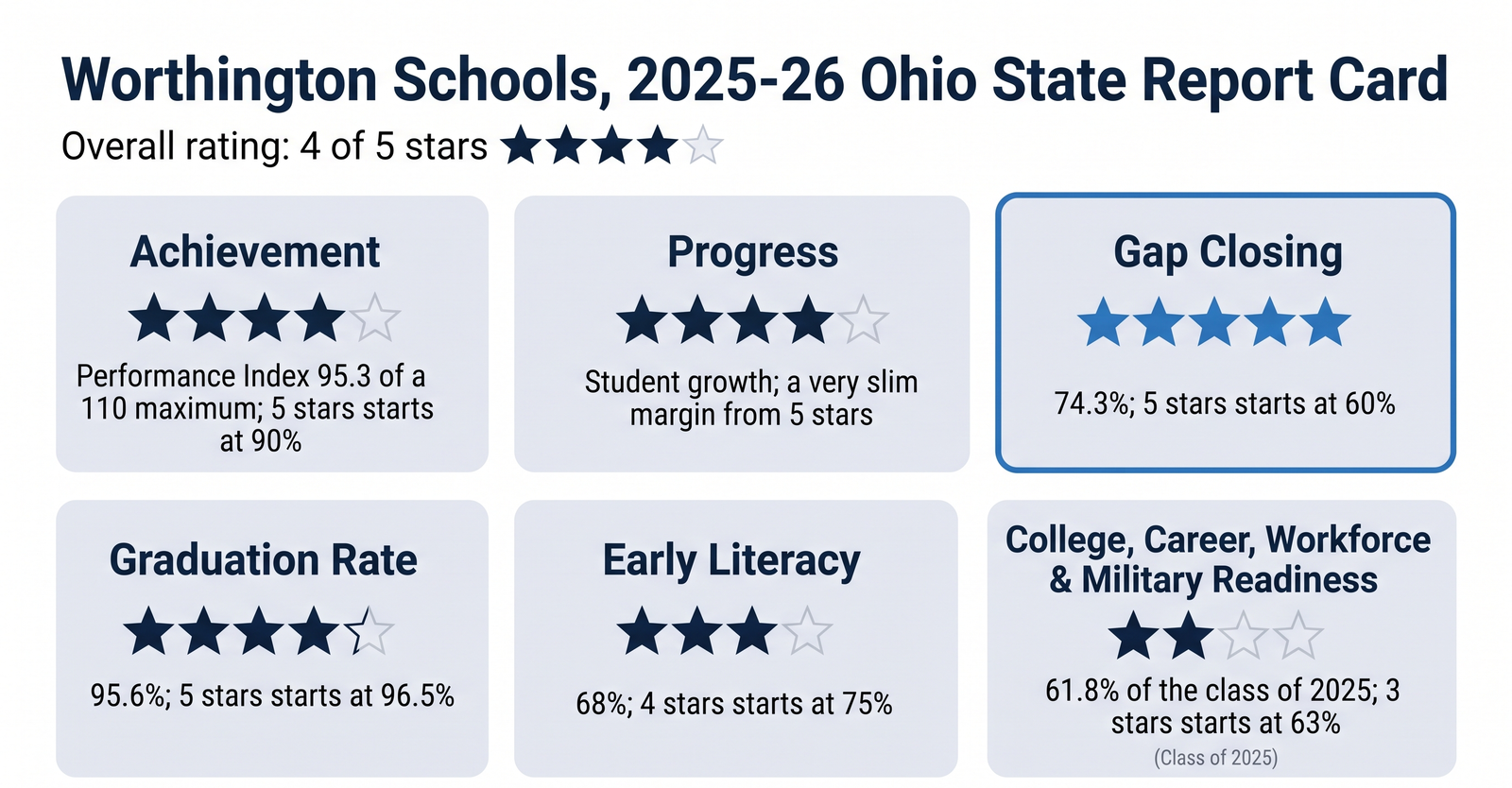 Worthington Schools' ratings on Ohio's 2025-26 state report card. Source: Worthington Schools presentation to the Board of Education, Sept. 28, 2026.
Achievement is based on the state's Performance Index, which counts every tested student in every tested subject from third grade through high school. Students earn the district more credit the higher they score across six performance bands, from "limited" to "advanced plus," so the measure is not a simple pass rate. "In this metric, there are six finish lines," Griffin said. Worthington's index has risen from 92.6 in 2022 to 95.3 this year, the highest in that span.
Progress measures growth: how far students moved compared with what their earlier test scores predicted. Griffin said the district was "0.02% away from hitting the five star mark" on that component, and that a change in either progress or achievement would lift the overall rating by half a star.
Gap closing looks at whether individual student groups are meeting state goals in English and math achievement and growth, graduation, English learner progress, chronic absenteeism, and gifted services. Griffin called the five-star result the measure that most closely reflects daily classroom work. "This five-star rating tells us that when we look at a granular level at all of our student subgroups, that they're all performing well and we're not leaving any particular demographic or socioeconomic status or learning program like kids on IEPs behind in this metric," he said.
On graduation, the district's weighted rate was 0.9 percentage points short of five stars. Griffin estimated that gap at "15 to 20 more kids across the finish line".
A rule change after the year ended
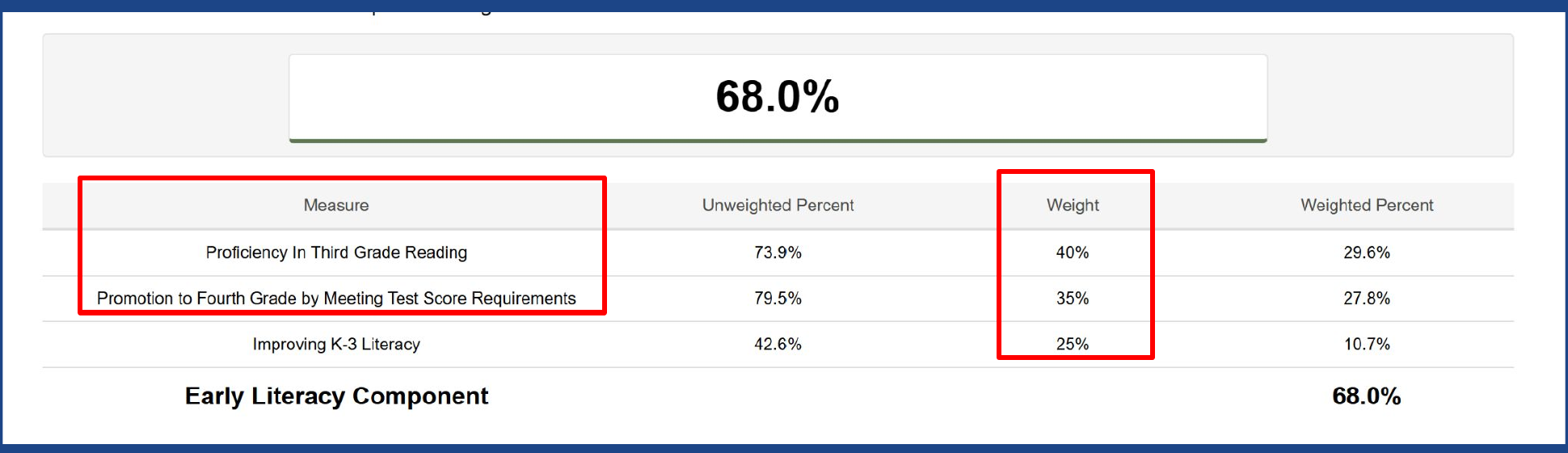 The three measures behind Worthington's early literacy rating, with the state's weights.
Early literacy covers kindergarten through third grade and blends three measures: third-grade reading proficiency (40%), promotion to fourth grade (35%), and how many struggling K-3 readers move from off track to on track in a year (25%). Worthington's scores on those three were 73.9%, 79.5%, and 42.6%.
The second measure (promotion to fourth grade) changed this year. Under House Bill 96, a student counts as promoted for report card purposes only by reaching a qualifying score on the state reading test or an approved alternative test. Promotions through a parent request or other exemptions no longer count, though those students can still move on to fourth grade. Griffin said districts learned of the change after the school year was over, and that it turned three quarters of the component into a measure of test achievement.
"It wasn't even changing the rule in the middle of the game, the game was over and we learned of the rule change," he said. Under the previous rules, he said, Worthington would have scored 75%, the threshold for four stars.
Griffin said he does not object to the change itself. "It never made sense to me that you could get 100% on promotion in the fourth grade through a parent exemption. It doesn't really reflect whether or not a child is reading or not," he said. But he told the board that a measure weighted this heavily toward achievement tracks family income and English proficiency closely, which makes it harder for a district with Worthington's range of students. Four stars is possible in a given year, he said, but "not something that I would tell the Board of Education to expect every year" [confirmed 0:18:13].
One adjustment is coming. Griffin said the district will use its MAP assessment this year as the alternative test for the promotion measure, in place of the TerraNova test it used in earlier years, and expects to improve on that measure as a result.
Vice President Stephanie Harless said the three-star rating did not concern her. "We are very proud to be a public school that welcomes every kid where they are and then lifts them up," she said.
Stay connected to what's happening in Worthington, Ohio.
The lagging two-star rating
The district's lowest rating is on college, career, workforce and military readiness, a component added to the report card last year. It counts graduates who meet at least one of 11 state-approved indicators, such as a remediation-free ACT or SAT score, an honors diploma, 12 college credits, industry credentials, an apprenticeship, or military enlistment.
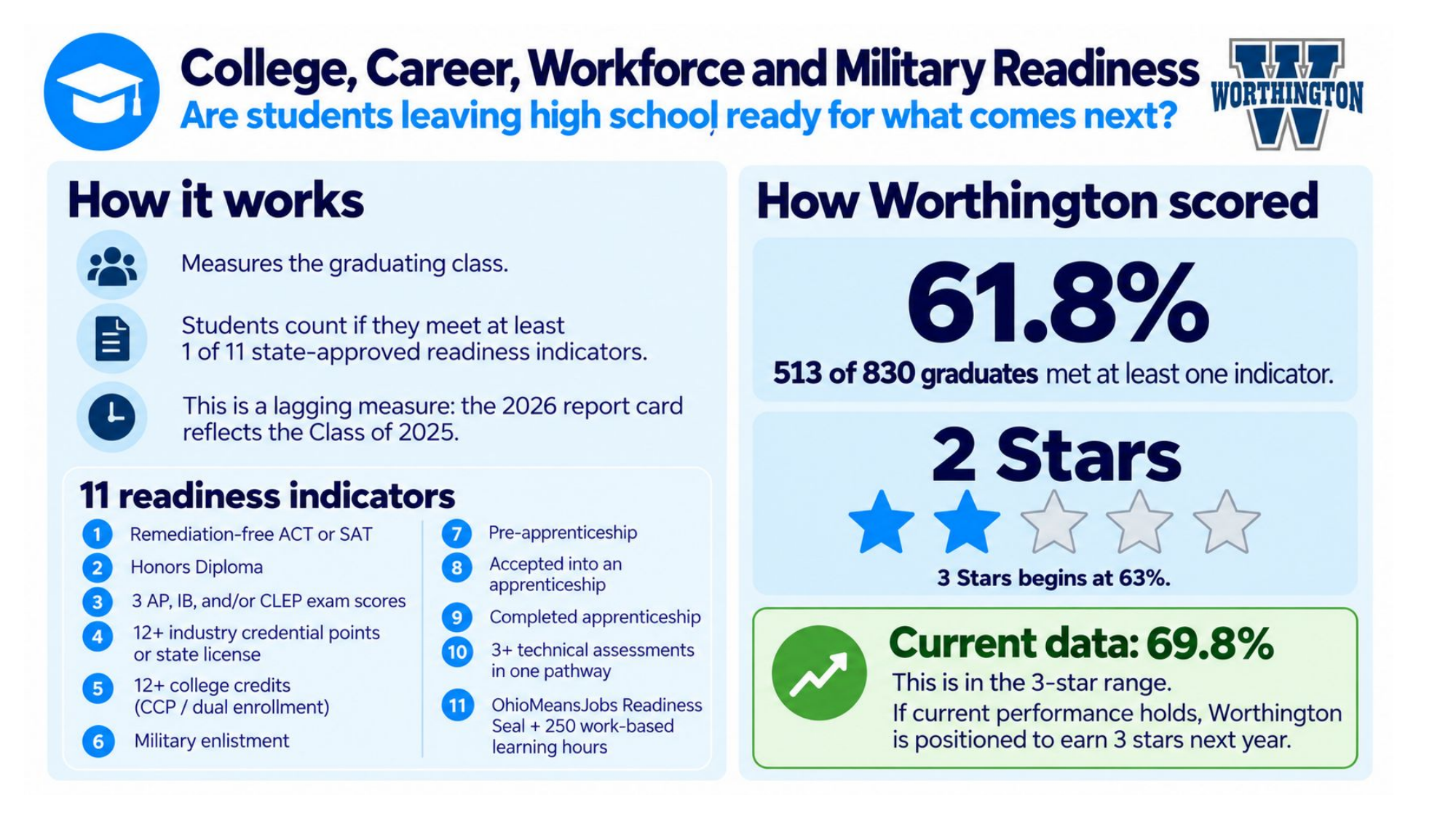 The 11 readiness indicators and Worthington's results for the class of 2025, with the district's current figure for the class of 2026.
The measure runs a year behind. This year's rating reflects the class of 2025, in which 513 of 830 graduates, or 61.8%, met at least one indicator. Three stars begins at 63%. The district's slides put current data for the class of 2026 at 69.8%, which Griffin said should produce a three-star rating on next year's report card.
Board members asked whether the district is getting credit for everything its students do. Griffin said local choices affect the number. Some districts require students who take an Advanced Placement class to sit for the AP exam, and a passing score counts toward the measure. "We don't make that requirement. I'm not so sure we should," he said. He said the district has asked itself whether changing that would be "chasing stars" or whether there are good reasons to keep its current approach. A district administrator answered follow-up questions on tracking the indicators from the audience, off microphone. [Editor note: the off-mic answers were at 0:41:31 and 0:47:07 in the video, potentially from Emilie Greenwald.]
Other ways the district reads the numbers
Griffin offered three other views of the same test results. Compared with a year earlier, proficiency rates rose on 14 of the 20 state tests, with the largest gains in eighth-grade English language arts (68.5% to 74.2%), high school English II, sixth-grade math, biology, and eighth-grade math. He cautioned that each year's results come from different students taking a different test.
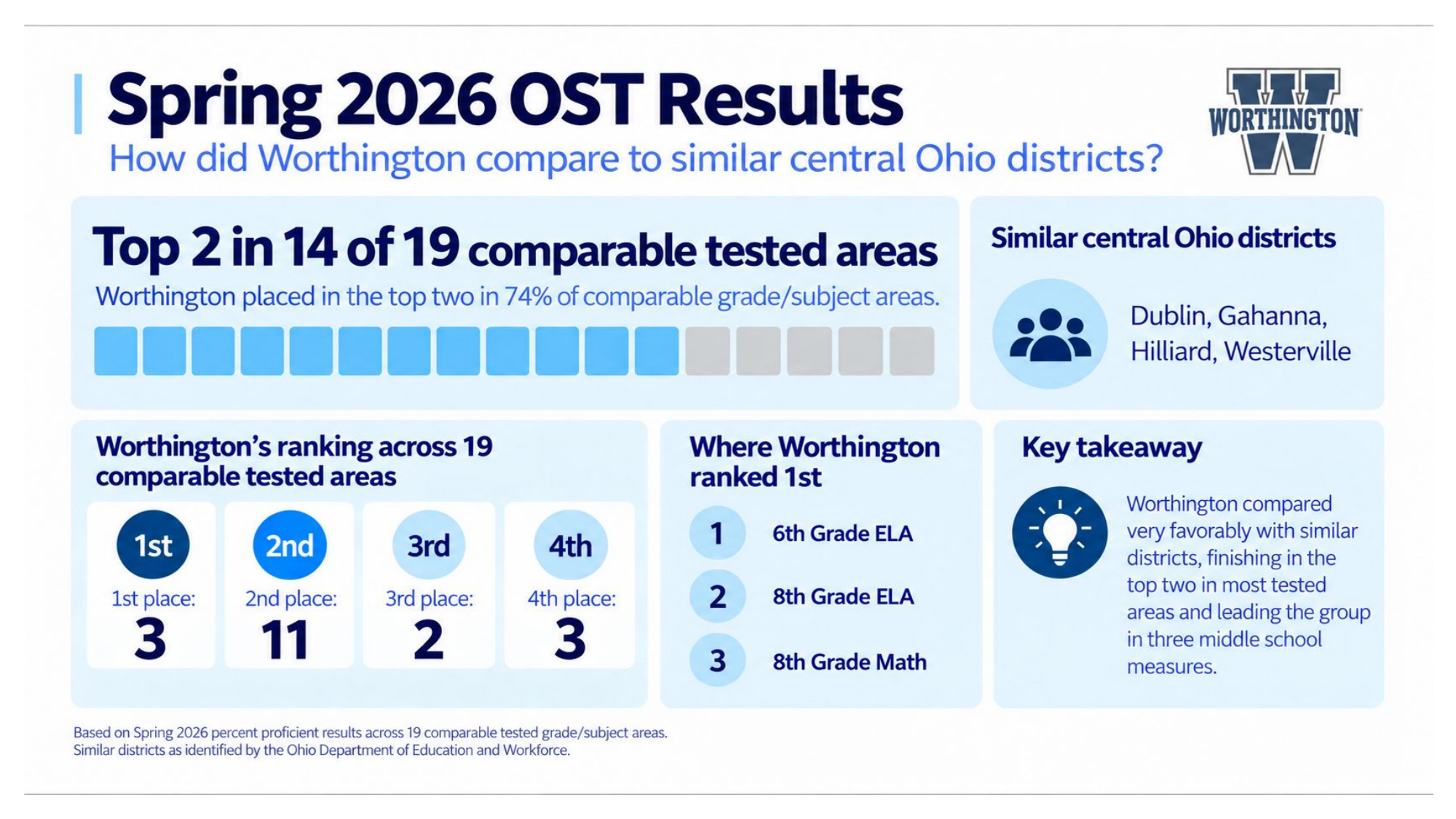 How Worthington ranked against four similar central Ohio districts on spring 2026 state tests.
Against the four central Ohio districts the state classifies as similar (Dublin, Gahanna, Hilliard and Westerville), Worthington ranked first or second in 14 of 19 comparable tests and first in sixth-grade English, eighth-grade English and eighth-grade math.
His preferred measure does not appear on the report card: a nationally normed score that shows whether students are holding their place relative to peers across the country. Middle school reading rose 2.9 points to 59.0, the highest in ten years of district data, and elementary reading rose 1.9 points to 58.5. Math rose by less than a point at both levels. Griffin said the middle school reading gain is "probably the curriculum effect", though he said he could not be certain. The 2026 figures are estimates, according to the slides.
How much weight to give it
A board member asked whether districts are effectively penalized for students who move in and out. Griffin said they technically are not, but that the report card picks up family income, English proficiency and student mobility along with instruction. "It's actually the most challenging data set that we get," he said, "and it's quite often misunderstood".
He said the report card is a summary the district checks against its own data, while day-to-day teaching decisions come from classroom screening and curriculum assessments given throughout the year. "We're aware of the report card but it's just a backdrop," he said.
Board President Amber Epling-Skinner said she was proud of the rating and also glad to see how close the district sits to the next tier. "I too am proud of the four," she said, before continuing: "I also am just competitive and I love that you included in your presentation just how close we were to the next tier".
The rating also affects state funding. Treasurer Thomas (TJ) Cusick said in his report that the state budget now pays districts a performance supplement based on their report cards. Worthington received a little over half a million dollars last year and will receive that amount again based on this year's results.
Residents can look up Worthington's full results, and the technical documents explaining each component, on the state's Ohio School Report Cards site.
This story comes from the September 28 meeting recap.