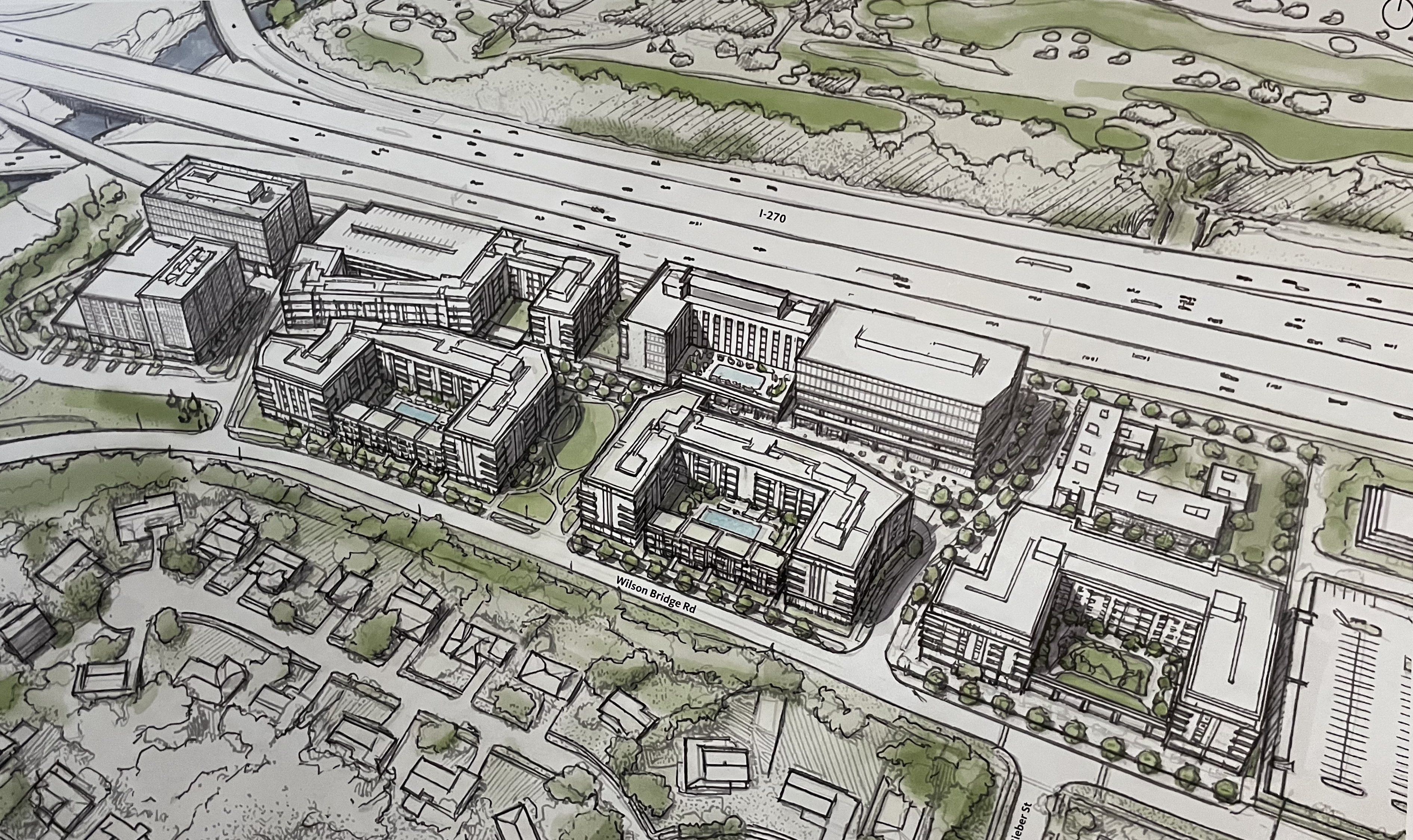
 (Early Conceptual Design, not finalized)
Hello Worthington! Here's your recap of what happened at April 8's Crawford Hoying community meeting. This was a small developer-hosted session for nearby residents to present initial concepts for the site to the west, and to gather community feedback for this early stage of the planning process.
Crawford Hoying Plans to Replace Three Office Buildings with a Walkable Mixed-Use Neighborhood
Crawford Hoying, the developer behind Bridge Park in Dublin, presented its early stage concept for redeveloping three aging office buildings on West Wilson Bridge Road into a mixed-use neighborhood at a community meeting on April 8. The concept calls for approximately 400 residential units, 100,000 square feet of retail, 150,000 square feet of office space, and two hotels across roughly 20 acres. Rezoning is targeted for completion by November 2026, with construction projected to begin in 2028 if the process proceeds on schedule.
The Parcels and the Developer
Russell Hunter, Executive Vice President of Development at Crawford Hoying, led the presentation held April 8 at 250 West Wilson Bridge Road. He was joined by Andre Brumfield, principal at Gensler, the firm serving as master planner; Zach from Gensler's Urban Design studio; and representatives from Realm Collaborative, the landscape and public space design firm on the project.
The three parcels being redeveloped are 400, 450, and 500 West Wilson Bridge Road — the westernmost office buildings in the complex. The meeting was held at 250 West Wilson Bridge Road, a building Crawford Hoying also owns but that is not part of the greater redevelopment.
"This is the first of several meetings that we'll have with the community," Hunter said noting that planning commission hearings and multiple meetings with city staff would follow. "We are really, really early in the process."
Stay connected to what's happening in Worthington, Ohio.
The Plan
Gensler's master plan concept organizes the development around a curving interior commercial street lined with retail and restaurants on both sides, a centralized park at the rear of the site, and varied building heights along the West Wilson Bridge Road frontage. Multifamily residential buildings could reach four to five stories while interspersed townhomes along West Wilson Bridge Road would be two to three stories to provide visual distinction at the street edge.
The current development program: approximately 400 residential units across three phases, 100,000 square feet of retail, 150,000 square feet of office — roughly the same square footage as the three existing office buildings — and two hotels. The team made the comparison to Bridge Park which has 25 acres, 750 units, 550,000 square feet of office, and two hotels.
Two free parking structures, modeled on Bridge Park's approach, would be located at the rear of the site. "They're free, which has always been a competitive advantage for us at Bridge Park," Brumfield said . A service road behind the structures would connect them and provide access to signalized intersections. Some secured residential parking may be incorporated inside buildings depending on the final housing product type.
Gensler outlined five guiding design principles:
- Prioritizing ground-floor activation
- Pedestrian permeability throughout the site so it does not feel "walled off"
- A mix of housing types and uses
- Varied intimate public spaces every 150 to 250 feet
- Design quality using authentic, durable materials.
The interior commercial street is designed so that both sides are active at ground level — retail and restaurant on both sides.
Crawford Hoying said it intends to use multiple architects working under shared design guidelines — a deliberate departure from Bridge Park's early blocks, which were developed by a single firm. "[We are] setting the guidelines upfront and then making sure that whoever designs that building is not the guy that designs [the next] building... it just feels better, it feels great."
Materials will include masonry, brick, glass, and steel, similar to Bridge Park, but with a contemporary feel the team described as "21st-century Worthington" while respecting the character of the existing community.
Traffic and West Wilson Bridge Road
Traffic on West Wilson Bridge Road was the longest and most active topic of the evening. Hunter identified the westbound backup at an existing intersection west of the site (Olentangy River Road and West Wilson Bridge Road) as the development's most significant external challenge.
"Probably the biggest conclusion we've come to is the thing that is completely outside of our control... it's westbound traffic along West Wilson Bridge Road," Hunter said. Hunter advocated specifically for a turn lane at the Olentangy River Road intersection. "If you can figure out how to get a turn lane in at Olentangy River Road, that will alleviate half of the problem on West Wilson Bridge," he said, noting that cars blocking through traffic at that intersection are a daily source of backup.
The current traffic approach calls for disconnecting the site's internal road from the Rieber Road intersection, discouraging vehicles from using the development as a cut-through to the neighborhood to the south. The primary signalized access point would be at the west end of the site. All other West Wilson Bridge Road access points would be "right-in/right-out" (encouraging right hand turns).
Hunter cited Crawford Hoying's experience at Bridge Park as a model for what partnership with city engineering can achieve. Riverside Drive was reduced from a 45 mph road to 25 mph through a collaborative process. "What a difference it made... there's a real...actual sense of walkability," Brumfield said. "It takes partnership with the community to say, we want something different for our street. This is a real opportunity for that."
Hunter noted that Crawford Hoying's traffic engineering team has had approximately two dedicated traffic-focused meetings with city staff to date and said more clarity should emerge over the next six months.
Neighborhood Concerns: Density, Height, and Light
Residents living adjacent to the site raised concerns about building density and proximity to single-family homes. One resident described the plan as overdeveloped. "When I look at this schematic, the first thing that I see is that this plot of land is overdeveloped," the resident said, pointing to what appeared to be development filling every portion of the parcel and asking how multi-story buildings backing up to single-family lots would affect noise, light, and the character of the neighborhood. The resident also expressed concern about pools and amenity noise from the development. Brumfield responded that buildings are currently planned 35 feet off the property line and noted the plan remains a concept-stage sketch.
On light pollution, residents asked how the development would handle light impacts on neighboring homes. Hunter responded that conditions are likely to improve compared to the existing situation. "A lot of yards are looking over a parking lot full of lights right now," he said. He indicated the development would follow standard dark-sky lighting practices and suggested that building walls and landscaping would provide more structure to contain light than the current open parking lot.
Multiple residents also spoke in support of the project during the meeting. A resident with a commercial real estate background offered a wider perspective, stating that Worthington has historically constrained development in ways that have left the community behind, and that the program Crawford Hoying has proposed reflects what the market can support: "When an expert like Crawford Hoying and Gensler come in and design this and tell us, this is the mix that's gonna be successful, we have to listen to the experts".
Stay connected to what's happening in Worthington, Ohio.
Hotels and Conference Space
Two hotels totaling approximately 300 rooms are planned for the site. Crawford Hoying has had conversations with Marriott, Hilton, and Hyatt, and Hunter reported positive early interest given existing hotel demand in the area.
One resident noted that there was a loss of a large gathering and conference space when the Holiday Inn closed, and asked whether the new hotels could incorporate meeting facilities of that kind. Hunter said he appreciated the input and that integrating community needs like conference space into the design early would be helpful. "The sooner we can do that, the better. Because then we can really start to think about how we can integrate it into the design," he said.
Multimodal Connections and the Olentangy Trail
Crawford Hoying and Gensler said the development presents an opportunity to improve access to the adjacent park and ultimately to the Olentangy Trail. Hunter described the existing park access road as dangerous. "I have driven down that cool road to get down to the parking lot at the bottom of that hill. Man, coming out of that is taking your life in your own hands," Hunter said, adding that city staff responded immediately with shared interest when Crawford Hoying raised the issue.
One concept discussed is the possibility of incorporating overflow park parking into the development's structures — a "blue sky" idea that could expand park access while keeping the park area open.
Residents discussed the multimodal bike lane on the West Wilson Bridge Road bridge, describing it as narrow and dangerous. Hunter said there had historically been a concept for a dedicated overhead West Wilson Bridge connection and committed to advocating for whatever improves corridor multimodal access.
Economic Benefits and TIF Financing
A representative from the consortium confirmed that Tax Increment Financing — TIF — will be necessary to fund parking structures, streets, and other infrastructure. "We cannot pay for parking garages, streets, infrastructure — it will not work," they said. "So we will use [TIF] to redirect those tax dollars to that infrastructure."
Crawford Hoying described the economic benefit to the city as primarily income-tax driven — from construction workers during the build, and from office workers and residents over the long term. Hunter noted that Worthington operates as an income tax community and said the project is structured to attract and retain office employment and catalyze broader development in the corridor.
Crawford Hoying has had one meeting with Worthington City Schools. They indicated that a more detailed fiscal impact analysis is still in development but said the general outlook from comparable projects is that a high-density mixed-use development generates substantially more tax revenue per pupil than it adds in school enrollment.
Timeline
Hunter outlined a best-case timeline:
| Date | What |
|---|---|
| November 2026 (target) | Rezoning and master plan completion |
| 2027 | Building design and tenant relocation from 400, 450, 500 W. Wilson Bridge Rd |
| 2028 | Construction start (contingent on rezoning) |
| TBD | Planning commission hearings — public comment opportunities |
Note: No specific public meeting dates were announced. Crawford Hoying said it will create an ongoing community input channel and hold additional community sessions.
The group emphasized this schedule depends on a smooth rezoning process and resolution of tenant leases, which they described as a significant variable.
Next Steps and Community Input
Crawford Hoying will create an ongoing community input channel — the April 8 session did have a sign-up sheet for residents (Worthington Pulse did sign up, so we will bring you that news as we get it!).
Planning commission hearings will follow the rezoning application, with opportunities for further public comment. Hunter's stated priorities heading into that process: community members who support the project showing up to hearings; city partnership on West Wilson Bridge Road improvements; and a direct feedback channel between Crawford Hoying and the community.
Thanks for reading this summary of the Crawford Hoying community meeting. Learn more about Crawford Hoying here. We will bring you more information as we receive it!