
This story is part of Worthington Pulse's coverage of the October 5 City Council meeting. Start with the October 5 meeting recap.
Worthington City Council approved $265,000 to finish the engineering design for the Kenyon Brook trunk sewer improvement (Ordinance 32-2026), the last major piece of a decades-long effort to stop sewage from overflowing during heavy rain in the southeast part of the city. The money pays for final plans that can go out to bid for construction. The vote was 6-0. Council Member Glen Pratt abstained and stepped down from the dais because he owns property affected by the project.
Why the project exists
City Engineer John Moorehead called the project "the final major infrastructure piece of a multi-decade long effort" to cut sanitary sewer overflows. Marcy Bland, a consulting engineer with EMH&T who has worked on it since 2007, walked council through the history. In 2009 the Ohio EPA placed Worthington and the other communities that send sewage to Columbus under findings and orders requiring them to maintain adequate sewer capacity and take all feasible steps to stop overflows and basement backups. Worthington chose a 15-year "find and fix" approach: study the system, then repair it project by project.
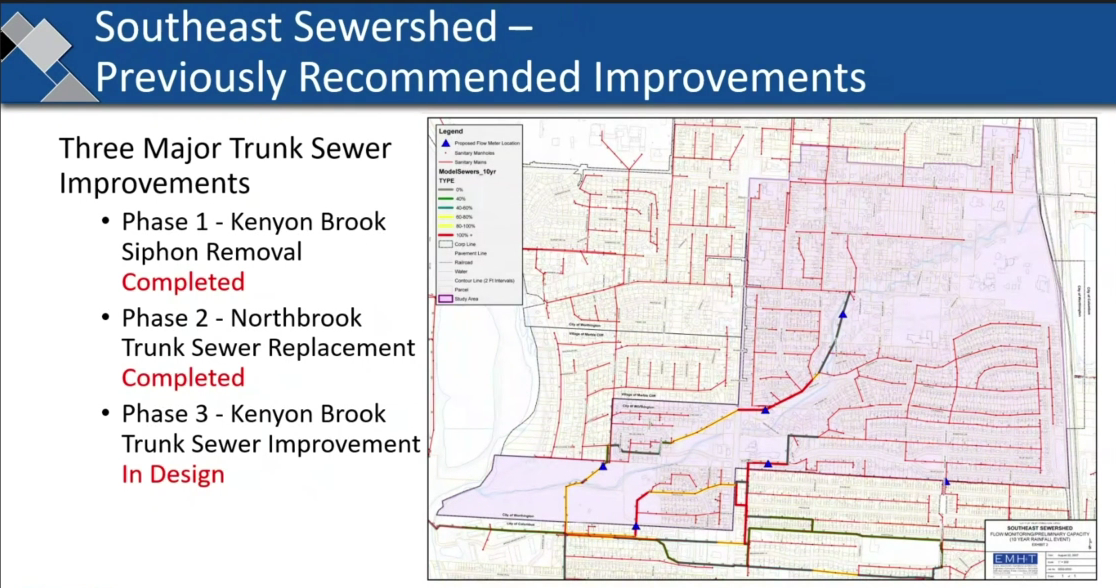 Consulting engineer Marcy Bland of EMH&T showed the three trunk sewer projects identified for southeast Worthington; the Kenyon Brook trunk sewer is the last one still in design. From the video at 2:08:51.
The design targets are tied to rainfall. The sewer must avoid overflowing in a 25-year storm, about 3.4 inches in six hours, and avoid backing up into basements in a 10-year storm, about 2.9 inches in six hours. "It's a large rainfall event, but we're getting them more often than we used to," Bland said. The city cannot design for larger storms, she said, because it cannot send Columbus's system more flow than it can take, and the cost would be prohibitive.
The Kenyon Brook trunk sewer is the third of three projects identified in the city's studies. The first, removing a sewer siphon on a Columbus-owned preserve, is finished. The second, the Northbrook sewer, was completed this year. Moorehead said the city has had 23 overflow incidents in 2026 so far, none of them along the Northbrook line, where the city saw a backup with every hard rain for decades. The Kenyon Brook project runs from High Street up to East New England Avenue.
Moorehead urged residents who experience sewer backups to contact the city, whose crews clean and inspect sewers year-round and can help determine whether a problem is public or private [confirmed 2:44:23]. Keeping rainwater out of the sanitary sewers by lining pipes and manholes takes sustained work, he said. "It's kind of a death by a thousand cuts problem," Moorehead said [confirmed 2:42:34], with improvement showing up only after a significant amount of that work, which the city is starting to see in the Kenyon Brook sewer shed.
The plan: a pump station and a pipe
Rather than dig up the creek corridor to replace the old gravity sewer, the city's preferred plan puts a wet-weather pump station at 141 East New England and pumps excess flow through a 12-inch pressure pipe, called a force main, to the west side of High Street, where Moorehead said there is capacity downstream. Bland said the city compared six alternatives, including one that would have built a large storage facility in Park Boulevard park, and the pump station and force main came out cheapest even with long-term operating costs. A 2019 estimate put the station at about $1.8 million, with annual operating costs of up to $16,000. The station would handle roughly 1,400 gallons per minute, and its building would be designed to resemble nearby homes.
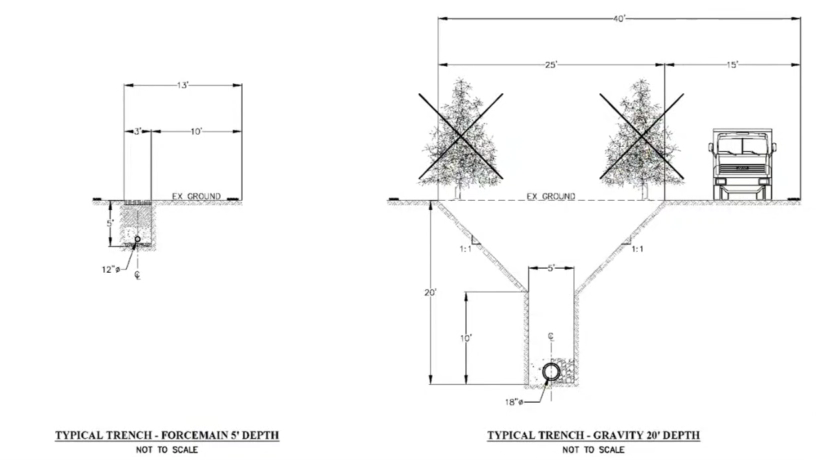 EMH&T's comparison of construction footprints: a 12-inch force main needs a trench about 13 feet wide, while a replacement gravity sewer would need a cleared path about 40 feet wide and 20 feet deep.
Replacing the gravity sewer would be harder, Bland said. It would need a cleared path about 40 feet wide, run into utilities along High Street, pass within about 10 feet of a swimming pool, remove mature trees, and leave a neighborhood with a single way in and out during construction. A force main fits in the right of way and needs only one easement, for the pump station site.
The old sewer stays in service. Moorehead said the existing trunk main through the neighborhood would be lined with a cured-in-place liner, essentially a new pipe inside the old one, which also seals the joints where roots and groundwater get in. Lining reduces the pipe's diameter, he said, but the pump station design accounts for it. The ordinance raises the design budget from the $250,000 staff had planned for 2026 to $265,000, which Moorehead attributed to the actual design fee coming in higher than the placeholder.
Bland said the city will still need Columbus to review the plan, because Columbus models how every Worthington project affects its system all the way to the treatment plant. Even with the project, she said, the sewers will still surcharge, or fill under pressure, during big storms, and she did not recommend that homeowners remove backflow preventers or ejector pumps.
Stay connected to what's happening in Worthington, Ohio.
The alternative neighbors asked for
Two residents spoke. The sewer runs directly beneath one resident's historic home, and he asked council to spend another $62,275 to have EMH&T design an alternative. The century-old clay trunk would be abandoned and replaced with a larger gravity sewer through the lower part of the neighborhood, and the force main would end there instead of crossing High Street. "For $62,275, I think we can get that answer," he said. A neighbor backed him and asked the city to weigh long-term options before committing.
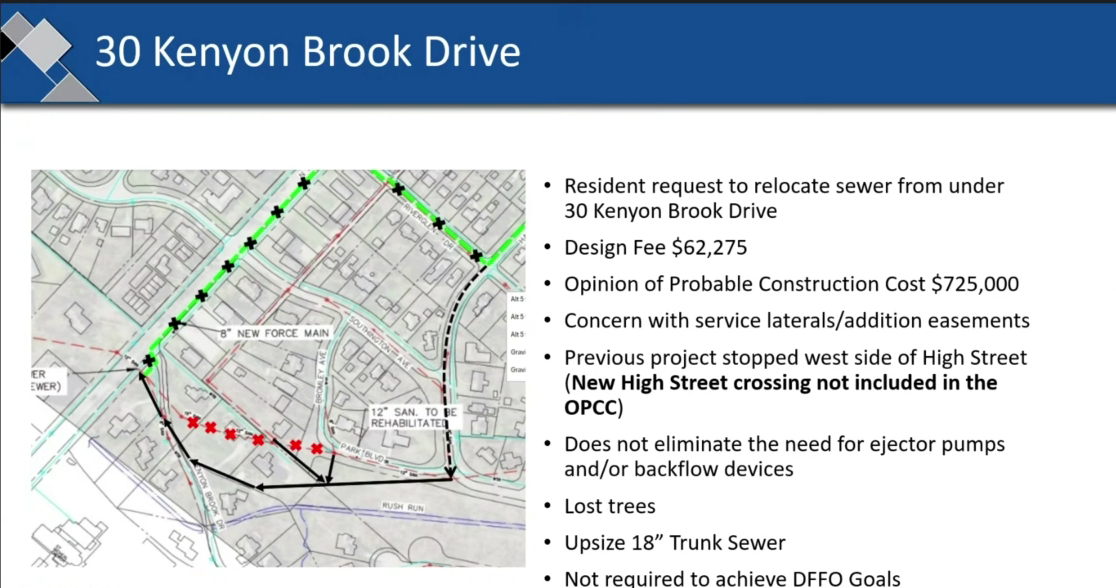 City Engineer John Moorehead walked council through the resident-requested alternative: abandon the trunk sewer under 30 Kenyon Brook Drive, build a larger gravity sewer through the lower neighborhood, and shorten the force main.
Moorehead and Stewart said the alternative would cost an estimated $725,000 to build, on top of the pump station and force main. That figure does not include a likely tunnel under High Street, which contractors price as high risk. The route would need easements across several properties and would run along private drives where gas and water lines sit. Some homes' plumbing would have to be reversed, and trees within 50 to 60 feet of the line would likely be lost. The resident said neighbors were willing to grant easements but no one had asked. One council member, Hermann, said she supported the direction staff had taken.
What's next
With design money approved, staff and EMH&T will complete plans for the pump station, force main, and pipe lining and send them to Columbus for review before the project goes out for construction bids. Council did not set a date for taking up the neighbors' proposed alternative.
This is one of 2 Worthington Pulse stories from the October 5 city council meeting recap.